The argument between manual and electric coffee grinders is usually presented as if one must be the serious choice and the other a compromise.
My coffee station makes that argument difficult.
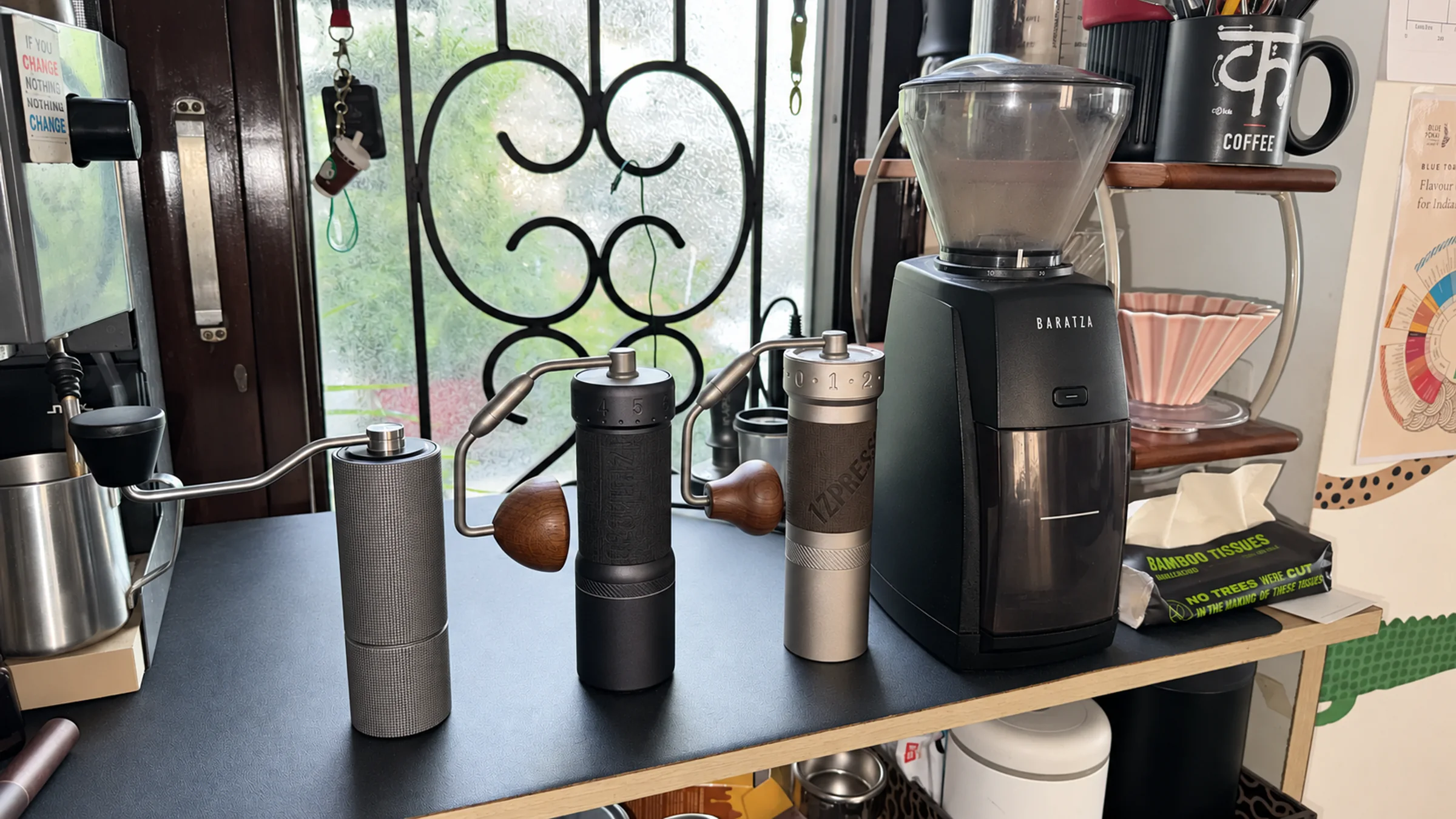
I own three hand grinders: a Timemore C2, a 1Zpresso J-Ultra, and a 1Zpresso ZP6 Special. I also own a Baratza Encore ESP electric grinder. I use all four.
If I am making pour-over and want clarity, I reach for the ZP6. If I am making espresso in the morning and feel lazy, I use the Encore ESP. If I have the energy to hand-grind for espresso, I use the J-Ultra. If I am travelling, the four-year-old C2 goes into my bag.
I have spent roughly ₹70,000 to ₹80,000 across these grinders. That amount could have bought one very capable premium electric grinder. I do not regret the route I took, because each purchase taught me what I value. You do not need to pay the same tuition fee.
The useful question is not simply, “Is manual or electric better?”
It is: what coffee do you make, for how many people, and how much work are you willing to do before drinking it?
The short answer
Choose a manual grinder if you:
- Usually brew one or two doses at a time.
- Make AeroPress, pour-over, French Press, or another manual brew.
- Want strong grind quality for less money.
- Value quiet operation, portability, and a small footprint.
- Do not mind making grinding part of the ritual.
Choose an electric grinder if you:
- Regularly make espresso and do not want a small workout first.
- Brew for three or more people.
- Grind large batches for cold brew.
- Need speed and convenience on ordinary working mornings.
- Have limited wrist, elbow, shoulder, grip, or hand mobility.
- Know that physical friction will eventually make you brew less.
Neither answer makes you more committed to coffee. The right grinder is the one that lets you make good coffee repeatedly.
My grinder progression, from 2022 to 2026
My current collection was not planned as a four-grinder system. Each grinder arrived when I could finally name a limitation in the previous one.
2022: Timemore C2, because pre-ground coffee was fading
I bought my Timemore C2 in 2022, two or three months after buying an AeroPress Go.
At first, I asked the shop to grind each bag for me. The coffee would taste good during the first few days or the first week, then seem to lose flavour with every subsequent brew. By the end of the bag, my AeroPress was no longer revealing what I had enjoyed at the beginning.
The brewer was not the problem. Grinding an entire bag at once had exposed far more coffee surface area to oxygen. I needed to grind each dose immediately before brewing.
The C2 solved that problem without requiring an expensive commitment. It became my only grinder for roughly two years. It also formed the compact setup I still recommend to many beginners: a capable hand grinder, an AeroPress, fresh coffee, and a basic scale.
Early 2024: Baratza Encore ESP, because espresso changed the requirement
When I returned to Delhi and began building an espresso station, the C2 was no longer the right tool.
Espresso needs much finer grinding and smaller adjustments between settings. Hand-grinding at that fineness is slower and harder, while a grinder with broad filter-oriented steps can make it difficult to move from a fast shot to a balanced one without overshooting.
I researched the available options and bought the Baratza Encore ESP in early 2024. If the DF54 had been available to me then, I might have chosen it instead, but that is hindsight. The Encore ESP had a strong reputation, a straightforward workflow, and a manufacturer associated with replaceable parts and repair rather than disposable appliances.
Baratza designed the original Encore ESP around espresso and filter use. Its first 20 settings provide the finer adjustment range, while the remaining 20 move through filter methods. The current official Encore ESP page describes it as an espresso-focused grinder with a dosing cup and hopper-based adjustment.
It remains my convenient morning espresso grinder. I also use its coarser range when grinding a large amount of coffee for cold brew.
2025: 1Zpresso J-Ultra, because I wanted more from espresso
In 2025, I felt there was still more information inside my coffee than the Encore ESP was showing me. I bought the J-Ultra to test that idea.
The J-Ultra is not objectively the best hand grinder for every person, but it is a grinder I trust for espresso. It was designed specifically for that job: 1Zpresso says its adjustment moves the burr by 8 microns per click, and its coated 48 mm burr is espresso-focused.
That fine control matters when a tiny movement can alter shot time and taste.
One espresso made the purchase immediately understandable. The bag described berries and jam. With the J-Ultra, perhaps because the coffee, recipe, temperature, and grind all aligned, I genuinely tasted them. It was the first espresso shot where the notes printed on the bag became that obvious to me.
The Encore ESP is still capable and far easier when I am tired. The J-Ultra gives me a cup that often feels more informative. It can expose more separation and detail, at the cost of making me provide the motor.
Early 2026: 1Zpresso ZP6, because pour-over had become its own pursuit
By January or February 2026, I was making enough pour-over to want a grinder designed around clarity. I bought the ZP6 Special.
1Zpresso describes the ZP6 Special as a pour-over grinder that produces fewer fines and greater clarity. It has 90 clicks per rotation and a 48 mm burr, giving me far more room to dial in than I felt I had with the C2.
The difference was immediately noticeable, although not supernatural.
Moving from the C2 to the ZP6 felt like changing headphones. Both let you hear the song. One reveals separation and detail that the other blends together. The C2 gave me only a small useful band of settings for pour-over; the ZP6 lets me make finer changes within that range.
The ZP6 did improve my pour-over. It also mainly showed me what I had been missing. It was not the life-changing revelation that equipment discussion can lead you to expect.
Manual grinders give you more mechanism for the money
A manual grinder does not need a motor, power supply, switches, or a large housing. More of its price can go into the burr, bearings, adjustment system, alignment, and body.
That is why a good hand grinder can compete in the cup with electric grinders that cost substantially more.
This does not mean every manual grinder is good or every electric grinder is overpriced. It also does not mean steel burrs automatically beat ceramic burrs. Burr geometry, stability, alignment, adjustment, construction, and the grinder's intended use all matter.
However, many very cheap electric grinders combine basic ceramic burrs with limited adjustment and weak motors. They may be sold as burr grinders, but that label alone does not guarantee consistent grounds or useful espresso control. Adding a motor to an entry-level mechanism can make a product more convenient without making the grind better.
If you are new to specialty coffee and mostly make manual brews, I would rather see the budget go into a competent hand grinder than into the cheapest electric option available.
The cost is physical effort
Grinding a normal pour-over dose by hand is manageable for me. Even a dense light roast is part of the ritual rather than a serious burden.
Espresso is different. Grinding light coffee fine enough for espresso requires noticeably more force. You can get used to it, but it remains work.
When I had tennis elbow, I stopped hand-grinding. That experience is a more useful warning than any abstract claim about whether manual grinding is “easy.” A grinder has to fit the body using it.
My girlfriend and my sister have both found some hand-grinding difficult. That does not support a rule based on gender; grip strength, joint health, grinder diameter, burr efficiency, roast density, dose, and technique all affect the experience. It does mean I should not assume that because a grinder is comfortable for me, it will be comfortable for everyone else.
If you have pain, limited mobility, reduced grip strength, or simply do not want physical work before coffee, buy electric. Convenience is not laziness when it makes the routine accessible.
Is an electric grinder too loud?
The Encore ESP is loud.
It is also loud for roughly 20 to 30 seconds, once or twice a day. That is acceptable in my home.
Noise becomes more important if you live with a sleeping baby, share a small flat, brew before everyone wakes, or have sensory sensitivity. A hand grinder is dramatically quieter. If none of those situations applies, I would not let a short burst of noise outweigh every other part of the decision.
This is a good example of why grinder reviews need context. A decibel reading can be accurate while still saying very little about whether the noise matters in your life.
Speed matters most when the dose multiplies
For one pour-over, hand-grinding feels easy. For two, it is still reasonable. Beyond two people, I want an electric grinder.
If two friends visit, I suddenly have three doses to weigh and grind. Even if each grind takes only a short time, the repetition changes the experience. An electric grinder lets me weigh each dose and allow the machine to do the tiring part while I prepare everything else.
The same applies to cold brew. I might grind a large batch on the Encore ESP at a remembered setting around 30 to 35, then adjust from there. I would not choose to hand-grind that volume merely to prove that I could.
For offices, families, guests, or frequent batch brewing, electric convenience becomes functional rather than decorative.
What I taste: C2 vs ZP6, J-Ultra vs Encore ESP
Grinder comparisons often become lists of particle distributions, burr shapes, and claims about clarity. Here is what those differences mean in my cups.
Timemore C2 vs 1Zpresso ZP6
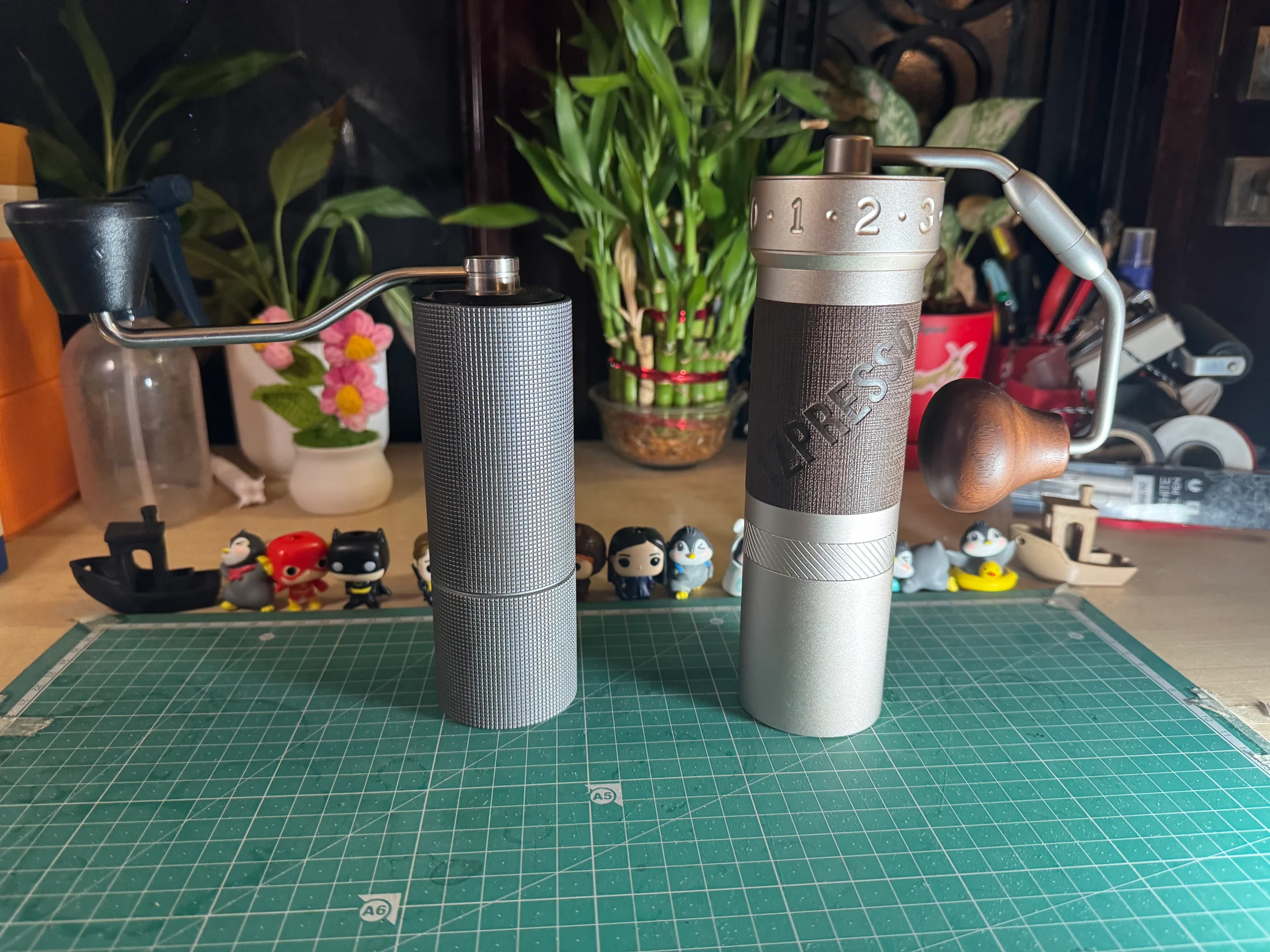
My C2 (left) and ZP6 Special (right), the two hand grinders in my pour-over comparison.
I have since brewed Araku Monsoon Edit side by side with both grinders. My Timemore C2 vs ZP6 comparison covers the settings, the heavier C2 cup, and why I preferred the ZP6 as the coffee cooled.
The ZP6 gives me more clarity and far more usable adjustment for pour-over.
With the C2, I had only a handful of clicks within the range I normally wanted to use. One step could create a larger change than I needed. With the ZP6, I can move through smaller adjustments until the cup has the balance I want.
That does not make the C2 bad. I used it happily for years and still travel with it. The comparison only became obvious because I brewed similar coffees closely enough to notice what the ZP6 separated.
1Zpresso J-Ultra vs Baratza Encore ESP
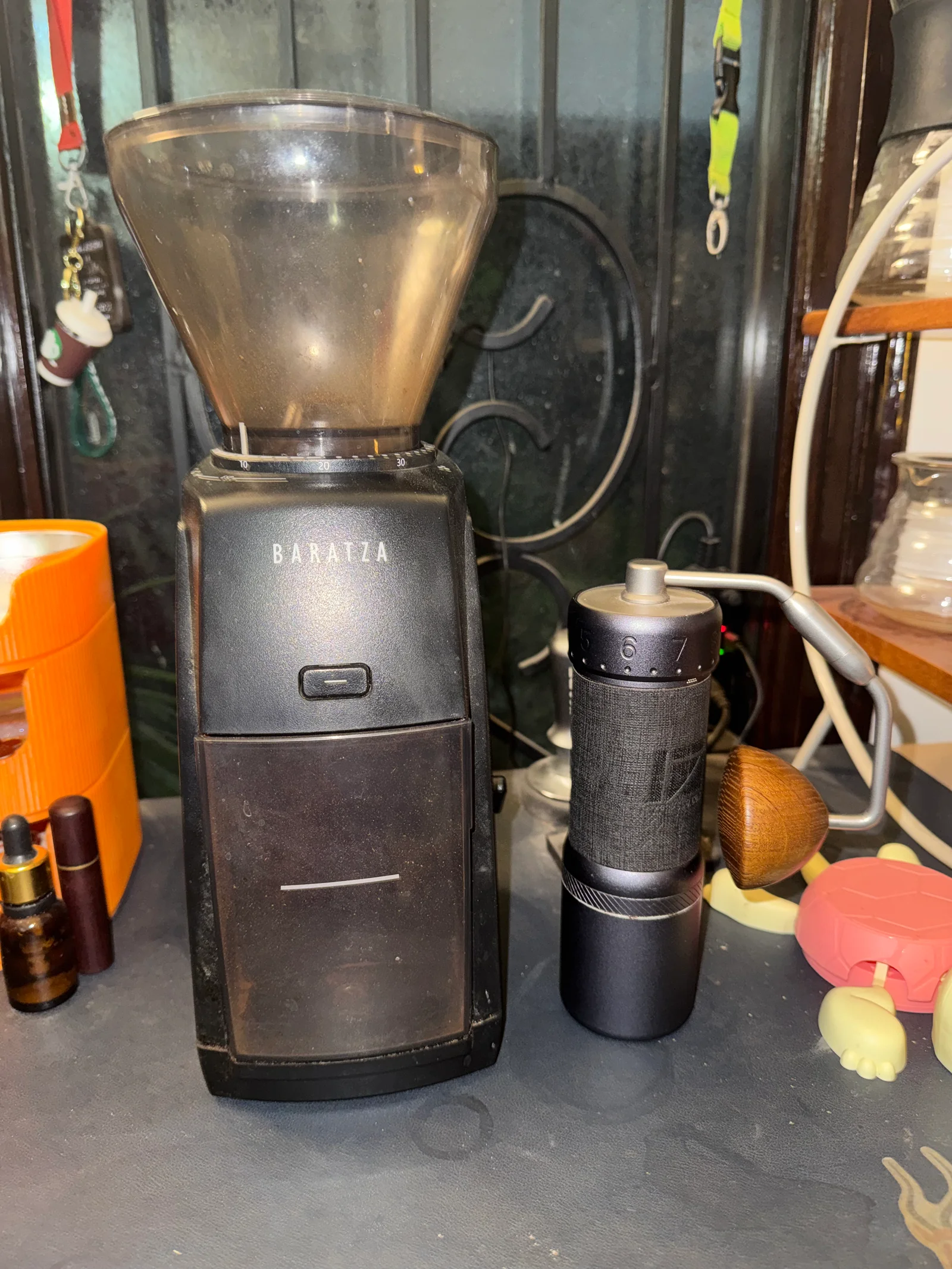
My Encore ESP (left) and J-Ultra (right): the electric and manual grinders I use for espresso.
The J-Ultra often gives me a more revealing espresso. The berry-and-jam shot is the clearest example.
The Encore ESP gives me very good espresso without asking me to work for it. On a hurried morning, that workflow advantage can matter more than the possibility of extracting another layer from the coffee.
This is why the manual-versus-electric debate has no universal winner. My preferred taste and my preferred routine do not always point to the same grinder.
One specialist grinder or one all-purpose grinder?
My J-Ultra and ZP6 sit at opposite specialist ends. The J-Ultra is built around fine espresso adjustment. The ZP6 is built around pour-over clarity.
The model I was trying to remember while dictating this article is the 1Zpresso K-Ultra. It is the all-purpose sibling in the range, with an external adjustment system and a burr intended to cover several brew methods.
An all-purpose grinder is often the more rational first purchase. A specialist becomes useful when you can explain what your existing grinder is failing to provide.
The same principle applies to electric grinders. A DF54 or DF64 may make sense for someone who wants one flat-burr grinder across espresso and filter, but availability, Indian warranty support, replacement parts, counter space, and current price matter as much as an international review. The DF54 uses 54 mm flat burrs, while the DF64 platform uses 64 mm burrs and supports a broader aftermarket ecosystem, according to the manufacturer's current comparison.
I considered a DF54 and DF64, and I paid toward a HiBREW G64 preorder before withdrawing. I eventually bought the ZP6 instead. I do not currently own a flat-burr or variable-speed grinder, so I will not pretend to give you a long-term ownership review of one.
What I would recommend to an Indian beginner
Prices and stock move too quickly for a permanent “best grinder under ₹X” list. Treat these as categories and starting points, then check the current Indian seller, warranty, and return policy.
For AeroPress or pour-over only
Start with a capable steel-burr hand grinder.
The Timemore C2 was that grinder for me. Today I would also look at the 1Zpresso Q Air, newer Timemore C-series models, and the KINGrinder P2.
The Q Air is officially a compact pour-over grinder with a 15 to 20 gram capacity, 30-click adjustment, stainless-steel burr, and a lightweight polycarbonate body. Its small capacity is appropriate for one cup, not a group.
As of August 2026, Indian listings put the KINGrinder P2 around ₹5,000, but availability has been inconsistent. That is a snapshot, not a promise. Compare delivered price and support before purchasing.
I have not personally owned the Q Air or P2, so those are current shortlist suggestions rather than firsthand endorsements. My firsthand entry-level recommendation remains based on four years with the C2.
For espresso only
Do not choose solely because a grinder claims it can reach an espresso-fine setting. It also needs sufficiently small, repeatable adjustments.
I can recommend the J-Ultra from experience, but it is an expensive hand grinder and espresso grinding is physical. Less expensive espresso-capable options exist from KINGrinder, Timemore, and 1Zpresso; compare adjustment size, workflow, grip, capacity, and local support rather than shopping by brand alone.
If you already know you will make espresso every morning, an electric grinder may be the more honest purchase.
For espresso and filter
Consider an all-purpose hand grinder such as the K-Ultra or X-Ultra, or an electric grinder designed to span both ranges.
The X-Ultra has 12.5-micron steps and is explicitly positioned for both pour-over and espresso. The K-Ultra provides broader external adjustment and a larger capacity. Neither will give you the exact specialist profile of both a J-Ultra and a ZP6, but that may be an advantage if you want one grinder rather than a collection.
For electric options, the Encore ESP, DF54, and DF64 families belong on the research list. Do not assume the most expensive or largest-burr model is automatically appropriate. Decide whether you value convenience, traditional espresso body, filter clarity, burr interchangeability, local service, or compact size.
For travel
Choose something compact, robust, and inexpensive enough that travelling with it does not create anxiety.
My C2 has accompanied me to hotels and work trips for four years. It is small, mechanically simple, and already carries the marks of use. I would be less upset if it were damaged than if the same happened to my J-Ultra or ZP6.
The Q Air is lighter and compact enough to fit inside an AeroPress plunger, according to 1Zpresso. Timemore's newer C-series grinders and the KINGrinder P2 are also worth comparing. A case is useful; a technically superior grinder you are afraid to pack is not.
Do retention, static, and cleanup decide the argument?
They matter, but not equally for everyone.
Hand grinders are mechanically simple. You weigh a dose, grind it, empty the catch cup, brush the grinder when required, and occasionally disassemble it according to the manufacturer's instructions. They are naturally suited to single dosing.
Electric grinders can retain grounds in the burr chamber and chute, create static, and require more cleaning. Some designs use bellows or short chutes to reduce retention. Hopper-based grinders may also exchange a little old coffee with a fresh dose.
In my routine, these differences are secondary to effort and speed. I use the dosing cup provided with the Encore ESP and tap the grinder when needed rather than turning retention into another accessory-shopping project.
The coffee accessories guide explains why I no longer buy a tool for every small inconvenience.
Did I waste money buying four grinders?
If I had put ₹70,000 to ₹80,000 into one excellent electric grinder, I might now own a simpler and more capable home setup.
But I would not have known that at the beginning.
The C2 taught me why fresh grinding matters. The Encore ESP taught me how much electric convenience changes espresso. The J-Ultra showed me what more precise espresso adjustment could reveal. The ZP6 taught me what clarity means in a direct grinder comparison.
That is the cost of acquiring experience. I do not regret it.
I also would still need something for travel. One premium electric grinder cannot go into a hotel bag with my AeroPress.
The mistake would be assuming that everyone needs to repeat my progression. This article exists so you can identify your likely destination sooner.
Buy when the limitation is real
Upgrade when you can finish this sentence:
My current grinder prevents me from ____, and I encounter that problem ____ times each week.
Useful answers include:
- Dialling in espresso because the steps are too large.
- Brewing for three people without grinding three doses by hand.
- Tasting the clarity I want from lightly roasted pour-over coffee.
- Making coffee comfortably because hand-grinding causes pain.
- Grinding a cold-brew batch without turning it into an exercise session.
“A reviewer made the new grinder look exciting” is not the same kind of answer.
My J-Ultra improved my espresso workflow and occasionally the cup in an obvious way. My ZP6 improved pour-over clarity, but it was not the revelation I had imagined before buying it. Both were defensible purchases. Both were also influenced by the promise that another grinder would reveal something extraordinary.
Curiosity is part of the hobby. It should not be allowed to disguise every desire as a requirement.
My final recommendation
For one or two manual brews a day, start with a good hand grinder. It will usually give you more grind capability per rupee, teach you how settings affect taste, remain useful for travel, and avoid committing you to a large appliance before you understand your habits.
For daily espresso, several drinkers, large batches, physical accessibility, or a routine where friction means skipped coffee, buy electric. The motor is not a luxury if it solves the problem you actually have.
If you know you want both espresso and filter, an all-purpose grinder can be more sensible than collecting specialists. If you later become deeply interested in one style, upgrade after your palate and workflow expose a specific limitation.
Keep one coffee and recipe steady while testing grind changes. Grinding Coffee: Why It Matters explains what finer and coarser settings do to extraction, and Brew Tracker can help you record the setting and result instead of relying on memory.
The sentence I want a beginner to remember is simple:
Buy for your needs, not your greed.
You may still become curious and buy another grinder. I did. Just make sure you know which problem you are paying to solve.