Coffee extraction sounds like a lab word, but it is really just this: water pulling flavour out of ground coffee.
That is the whole game.
When hot water meets coffee, it dissolves different compounds at different speeds. The bright, sharp, acidic compounds tend to come out early. Sweetness and body arrive after that. Heavier bitter compounds come later. A good cup is not about extracting everything. It is about stopping at the point where the cup feels complete.
This is why the same coffee can taste excellent one morning and oddly punishing the next. The beans did not suddenly betray you. The extraction changed.
The three common extraction problems
If your coffee tastes sour, thin, or grassy, it is often under-extracted. The water did not pull enough from the coffee. This can happen when the grind is too coarse, the water is too cool, the brew time is too short, or the coffee bed channels.
If your coffee tastes bitter, dry, ashy, or harsh, it is often over-extracted. The water pulled too much from the grounds, especially from the slower, harsher compounds. This can happen when the grind is too fine, the water is too hot, the brew time is too long, or you agitate the coffee too aggressively.
If your coffee tastes both sour and bitter, the extraction is uneven. Some grounds gave up too little, others gave up too much. This is common in pour-overs with bad pouring, clumpy grinds, or an uneven coffee bed.
Grind size is your main control
For most home brewers, grind size is the easiest adjustment to understand.
A finer grind gives water more surface area to work with, so extraction increases. A coarser grind gives water less surface area, so extraction decreases.
If your V60 tastes sharp and unfinished, go a little finer. If your French press tastes muddy and bitter, go a little coarser or shorten the steep. If your moka pot tastes burnt, grind slightly coarser and reduce the heat.
Make small changes. Coffee rewards boring adjustments more than heroic ones.
Time matters, but not alone
Longer contact time usually means more extraction, but time does not work by itself. A five-minute French press and a three-minute pour-over are not comparable because the methods use water differently.
Immersion brewers, like French press and AeroPress, let all the coffee sit with water. Percolation brewers, like V60 and Chemex, pass water through a coffee bed. Espresso forces water through a tightly packed puck under pressure.
So instead of chasing one ideal brew time, learn the useful range for each method.
For V60, many home brews land around 2:30 to 3:30. For French press, 4 minutes is a common starting point. For AeroPress, 1:30 to 2:30 can work well depending on recipe. These are not laws. They are starting points.
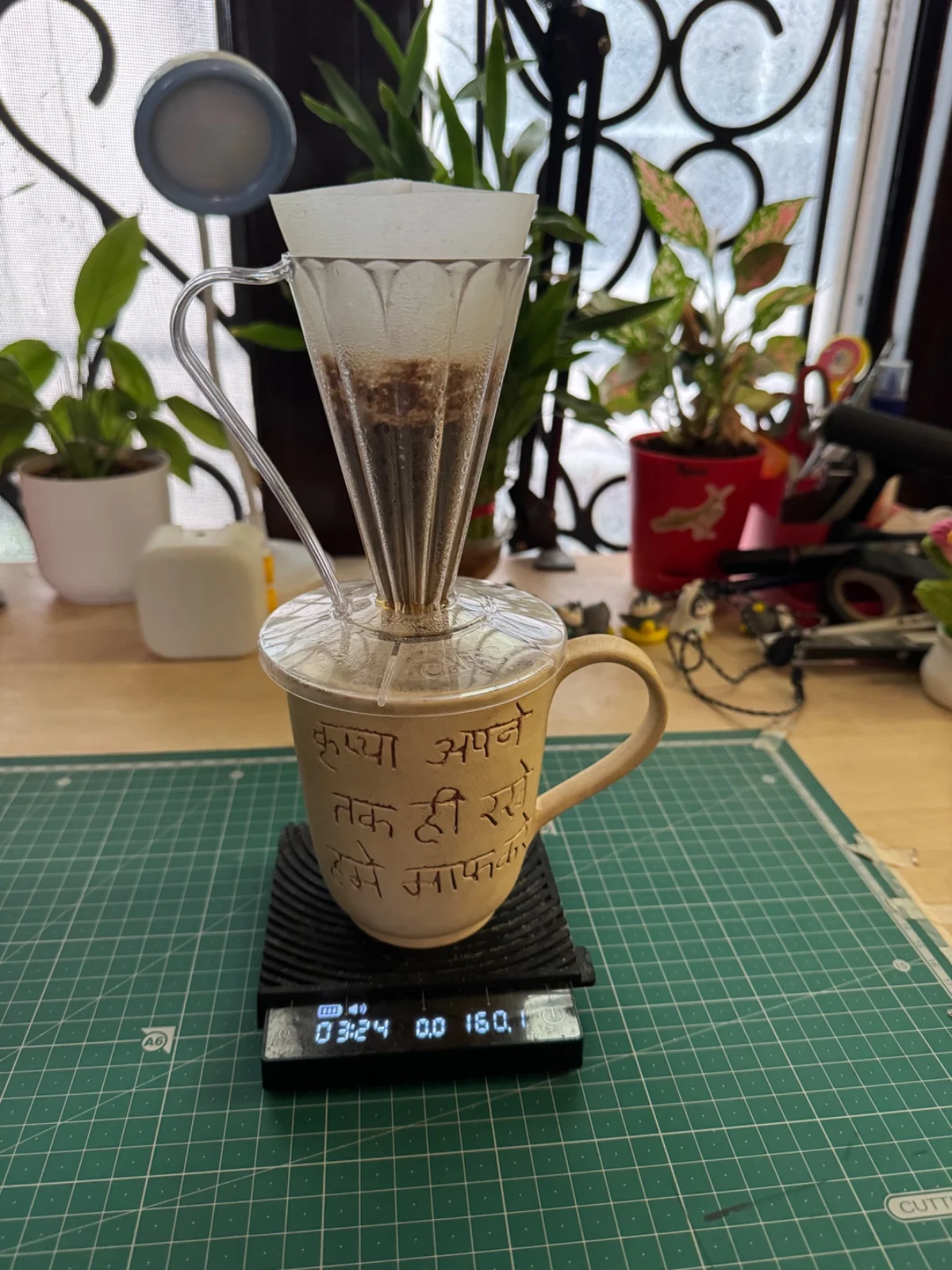
A pour-over with my CAFEC Deep 27. The scale helps me keep track of the brew while I adjust one variable at a time.
Water is not neutral
Water is the ingredient you use the most, and it is also easy to ignore.
Very hard water can make coffee feel heavy or muted. Very soft water can make it taste sharp or hollow. In many Indian cities, tap water varies wildly by building, filter, and season. If a coffee tastes strangely flat despite a decent recipe, try brewing once with a reliable bottled water and compare.
You do not need to become a water chemist on day one. Just know that water changes extraction.
How to diagnose your cup
Use taste as a compass:
- Sour and thin: grind finer, brew longer, or use hotter water.
- Bitter and dry: grind coarser, brew shorter, or reduce agitation.
- Weak but not sour: use more coffee or less water.
- Heavy and muddy: grind coarser, improve filtering, or reduce fines.
- Sour and bitter together: improve technique before changing recipe.
The Brew Tracker helps here because extraction problems are hard to remember honestly. Log grind, time, temperature, dose, and taste notes. After a week, patterns start showing up.
The useful takeaway
Good coffee is not magic. It is controlled extraction.
You are trying to dissolve enough from the coffee to get sweetness, aroma, acidity, and body, without dragging the brew into bitterness or dryness. Once you understand that, recipes stop feeling like rituals and start feeling like maps.
And maps are much easier to improve than vibes.