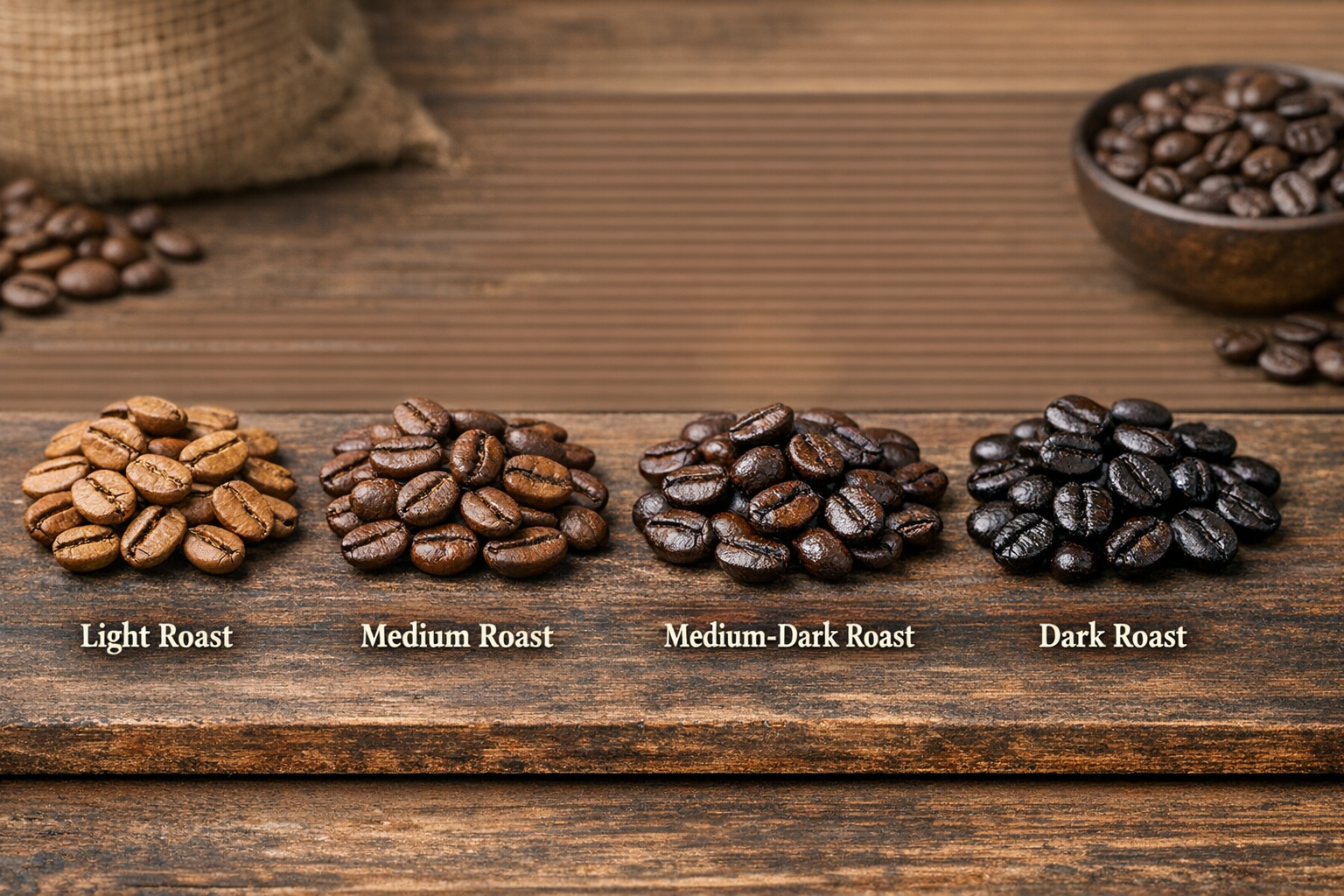
If you are getting started with Indian specialty coffee, the words light roast, medium roast, and dark roast appear everywhere.
The short explanation is this: roast level describes roughly how far a roaster has developed green coffee using heat. A lighter roast tends to preserve more acidity and origin character. A darker roast tends to emphasise flavours created by roasting: deeper browning, bitterness, toast, cocoa, and smoke. A medium roast usually occupies the large and imprecise space between them.
Those labels are useful, but they are not universal measurements. One roaster’s medium can look and taste like another roaster’s dark. Treat roast level as your first clue, not a guarantee.
If you already understand the labels and need help choosing a bag for pour-over, espresso, milk drinks, or South Indian filter coffee, use the companion guide: How to Choose the Right Coffee Roast for You.
And no, this is not roasting in the comedy sense. No coffee beans are being insulted, although some dark roasts taste as though they have been through enough already.
Coffee beans begin as seeds
A coffee “bean” is actually a seed found inside the fruit commonly called a coffee cherry. After harvesting, producers remove or dry the fruit using one of several processing methods. The resulting seed is dried and prepared as green coffee before being sent to a roaster.
Green coffee does not yet look, smell, grind, or brew like the coffee in your kitchen. During roasting it loses moisture and mass, expands, becomes more porous and brittle, changes colour, and develops hundreds of aroma and flavour compounds.
Roasting is therefore not simply making a bean hotter or darker. Time, temperature, airflow, the coffee itself, and the roaster’s decisions all influence the final cup. Researchers at the UC Davis Coffee Center describe roast profile as capable of changing perceived sweetness, sourness, roastiness, body, and mouthfeel even when the green coffee is the same.
What light, medium, and dark roast usually mean
There is more variation than a three-part label suggests, but this is a practical beginner’s map:
| Roast label | What you may find in the cup | What the bean may look like |
|---|---|---|
| Light | Brighter acidity, floral or fruit-led aromas, clearer origin and processing character | Light to medium brown, usually dry on the surface |
| Medium | A balance of acidity, sweetness, body, and roast character; fruit, caramel, nuts, or chocolate | Medium brown, usually dry |
| Dark | Lower perceived acidity, stronger roast character, bitterness, cocoa, toast, smoke, and heavier familiar flavours | Dark brown, sometimes shiny or oily |
These are tendencies, not promises. Origin, variety, processing, roast profile, freshness, water, grinder, and recipe can all move the experience in another direction.
A lightly roasted coffee is not automatically fruity. A dark roast is not automatically bad. “Medium” may be the least precise word in the entire coffee aisle.
What are first crack and second crack?
As coffee roasts, pressure builds inside the seed while water vapour and gases form and its internal structure changes. Eventually the beans produce a series of audible pops known as first crack.
First crack is an important marker for roasters, but it does not mean “medium roast” by itself. Many coffees sold as light or medium are dropped during or after this stage, depending on the coffee and the roaster’s intended profile.
If roasting continues far enough, a quieter second crack can occur as the bean’s structure breaks down further. Roasts approaching or entering this stage are generally in darker territory, although a label still cannot tell you the exact roast profile.
The important beginner lesson is not memorising roast milestones. It is understanding that light, medium, and dark are broad outcomes of a continuous process rather than three fixed settings on every roaster.
Why roast labels are unreliable
There is no single consumer-facing definition that forces every company to use “light,” “medium,” and “dark” in exactly the same way.
Professional roasters can measure colour using tools and reference systems, but retail labels remain relative to the company’s own range and target customer. A Starbucks medium roast, for example, has tasted decidedly dark to me compared with medium roasts from many Indian specialty roasters. That does not require anyone to be lying; the two companies are using different frames of reference.
Most Indian specialty roasters I have ordered from have been internally consistent. Once you understand a roaster’s range, its labels become more useful. The first bag is an introduction; the second tells you whether the vocabulary is consistent.
When buying from someone new, consider all of these together:
- The stated roast level
- Tasting notes
- Recommended brewing methods
- Whether the coffee is intended for milk or black coffee
- The roaster’s description of acidity, body, sweetness, and bitterness
- Photographs of the roasted coffee, when available
Can you judge roast level by looking at the beans?
You can make an educated guess, but appearance is not a laboratory result.
Very dark, shiny beans are often dark roasted. Oils can migrate towards the surface as roast development progresses, although storage time and other variables also affect their appearance. A pale brown, dry bean is more likely to be lightly roasted. A solid brown bean without visible oil often sits somewhere around medium.
Colour is useful only under reasonably neutral lighting and when you have comparison points. Camera processing, packaging photographs, uneven roasting, coffee species, and natural variation can mislead you.
Over time, you will build your own visual reference library. Until then, trust taste more than your phone screen.
What I have learned from drinking across roast levels
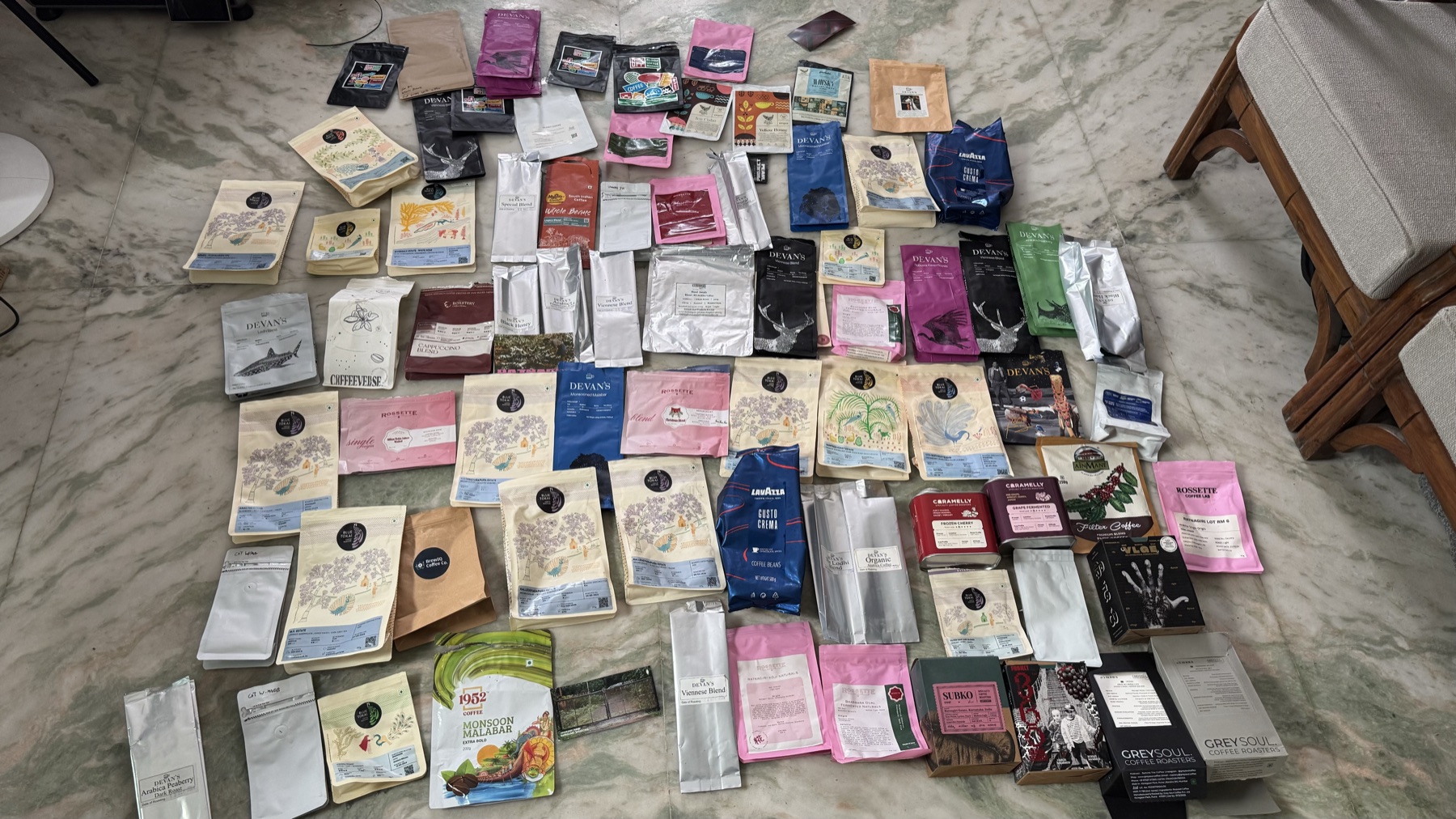
I have brewed coffee from Blue Tokai, Bloom Coffee Roasters, Devan’s, Coffeeverse, Karabi, Brew Clan, and many others. I have even tried very dark, oily IKEA coffee that I would not personally recommend.
You can explore many of the Indian businesses I have found through the Coffee Atlas, our growing directory of Indian roasters.
The broad lesson from all those bags is that roast level cannot be separated from how you intend to drink the coffee.
I have enjoyed light-roasted releases from Blue Tokai’s Producer Series, which the company describes as coffees roasted to foreground their natural flavours and experimental processing. I have also enjoyed their more recent coffees from Araku. Bloom has produced several coffees I have liked across different profiles.
For my morning milk drinks, I often prefer more traditional coffees. Devan’s Capi Robusta and Vienna Roast have worked well for me, as has Lavazza Gusto Crema. On the other hand, I have not enjoyed every dark roast: one Arabica Plantation AAA dark roast reminded me of the oily IKEA coffee and an old hotel-style cup. Darker is not automatically comforting, just as lighter is not automatically sophisticated.
Light roasts are especially individual. One can be floral and elegant; another can be aggressively fermented or simply unpleasant to you. That variation is part of their appeal, but it also means the label “light” tells you less than newcomers sometimes expect.
Which roast level works with each brewing method?
There is no law assigning one roast to one brewer. You can make espresso with light coffee and pour-over with dark coffee. The real question is whether the brewer, recipe, and roast produce the experience you want.
V60 and other paper-filter pour-overs
A V60 can present a coffee with clarity, making differences in acidity, aroma, origin, and processing easier to notice. That is why many people pair it with light and medium roasts.
A dark roast can still be brewed in a V60, but the clarity may reveal roast bitterness and smoke more clearly than you would like. If that is the flavour you want, it is not a mistake.
AeroPress
The AeroPress is forgiving and flexible. It can brew light, medium, or dark coffee using changes in grind, water temperature, agitation, contact time, and ratio. This is one reason I recommend it to beginners.
Espresso
Traditional espresso is associated with medium-dark and dark blends because those coffees are generally easier to work with and stand up clearly in milk. Modern espresso has expanded far beyond that tradition: lighter roasts, longer ratios, lower-pressure shots, turbo shots, and other contemporary recipes can produce bright and unusual cups.
That does not make traditional espresso obsolete. Some mornings I want an experiment. Other mornings I want a familiar cappuccino.
South Indian filter coffee
Medium-dark and dark coffee, often blended with robusta and sometimes chicory, fits the rich milk-and-sugar preparation many people associate with South Indian filter coffee. But the brewer can also be used to explore other coffees. The outcome may be less traditional, not inherently wrong.
Why can a light roast taste sour?
A sour light roast is often under-extracted, but “light roast equals sour” is too simple.
Lighter roasting leaves a denser, less roast-developed structure than darker roasting. It can therefore take a more assertive recipe to extract a balanced cup. In practice, I may grind finer and use water around 93–94°C for a light roast. With a dark roast, I may start closer to 86°C because I want to limit harsh roast flavours.
The crucial correction is that a light roast is not difficult to brew merely because it behaves like damp wood. All roasted coffee has already lost most of the moisture present in green coffee. The differences involve its physical structure, chemistry, roast development, and the flavours we are trying to extract. Studies of roasting show that moisture decreases across roast development while colour, porosity, density, acidity, and extractable compounds also change (research overview).
Water temperature alone also does not control bitterness. Grind size, ratio, contact time, agitation, water composition, and the coffee itself interact with it. In controlled research where strength and extraction were held constant, brew temperature had relatively little effect on the sensory profile of drip coffee (Journal of Food Science study). At home, however, hotter water can help extraction move faster when the rest of the recipe stays the same.
Use these as starting adjustments:
| If the coffee tastes… | Try… |
|---|---|
| Sour, thin, or empty | Grind finer, use hotter water, extend contact time, or use more water through the grounds |
| Bitter, dry, or harsh | Grind coarser, use cooler water, shorten contact time, or dilute the finished brew |
| Strong but still sour | Do not only add water afterward; improve extraction with grind, temperature, time, or technique |
| Pleasant but unfamiliar | Drink it as it cools before “fixing” it |
Change one variable at a time and record what happened. This is exactly why I built the Brew Tracker.
Which roast levels work with milk?
Milk softens acidity and bitterness while adding sweetness, fat, and texture. Coffees with chocolate, nut, caramel, spice, and deeper roast character usually remain easy to recognise through milk. That is why medium-dark and dark blends are common in cappuccinos and lattes.
A light roast can make an interesting milk drink, especially when its fruit character complements the milk. It can also taste oddly sour or disappear completely. I recently made a light-roast cappuccino that was interesting, but it left me wishing I had used my familiar Gusto Crema instead.
Black coffee is not the adult version of coffee, and milk is not a beginner’s failure. Choose the combination that makes the coffee enjoyable.
Blends are not inferior to single origins
Specialty coffee culture often presents single-origin coffee as serious and blends as cheap or compromised. That is another hierarchy beginners do not need.
A good blend is a recipe. A roaster combines coffees to produce a repeatable balance of body, sweetness, acidity, and roast character. Blends may also offer better value and behave more predictably across espresso and milk drinks.
A single origin can show you the character of one place, producer, lot, or process. A blend can show you the palate and intent of the person who assembled it. Both can be excellent; both can be disappointing.
What should a beginner buy first?
If you are moving from instant coffee into freshly brewed coffee, begin with a medium-roasted blend from a reputable Indian roaster.
Medium roast is not universally best, but it is a useful bridge: familiar enough to orient you, while retaining enough acidity and origin character to show why freshly roasted coffee is different. A blend is often less expensive and more forgiving than an experimental microlot.
A sampler is even better because contrast teaches faster than theory. The Blue Tokai 5-in-1 sampler review explains how to compare several profiles without buying five full bags.
For equipment, my personal beginner setup is an AeroPress and a Timemore C2 hand grinder. It is not the only valid setup, and you do not need to upgrade automatically. That combination can remain satisfying for years if it gives you the coffee you want.
A simple roast-level experiment
Buy three small bags from the same roaster:
- One light roast
- One medium roast or blend
- One dark roast
Brew them using the same device and starting ratio. Taste them black while hot, warm, and cool. Then try each with a small amount of milk.
Record:
- Which coffee smells most inviting?
- Which feels most acidic?
- Which feels most bitter?
- Which has the clearest fruit, nut, chocolate, or roast character?
- Which do you want to finish?
- Which works best with milk?
After the first comparison, adjust each recipe separately. The same recipe creates a fair initial test, but it will not necessarily make every roast taste its best.
Frequently asked questions
Is light roast better than dark roast?
No. Light roast can expose more origin and processing character, while dark roast can offer familiar roast flavours, lower perceived acidity, and a profile that works beautifully with milk. “Better” depends on the coffee, roast quality, recipe, and drinker.
Is dark roast stronger?
It often tastes stronger because bitterness, smoke, and roast character are more obvious. That does not automatically mean it contains more caffeine or that the brewed drink is more concentrated.
Is light roast always more acidic?
It commonly presents more perceived acidity, but origin, processing, roast profile, water, and brewing can alter the result. Acidity can be pleasant and fruit-like; sourness can also indicate an extraction problem.
What is the best roast for espresso?
Medium-dark and dark roasts are traditional, forgiving choices, especially for milk drinks. Light-roast espresso can be excellent but often requires more experimentation. Espresso is a brewing method, not a roast level.
What is the best roast for pour-over?
Light and medium roasts are popular because paper-filter pour-over can highlight clarity and origin character. You are still allowed to brew a dark roast if that is what you enjoy.
Can I identify roast level from oily beans?
Visible surface oil often indicates a darker roast or coffee that has been stored for some time, but it is not a complete measurement. Use colour, aroma, the roaster’s description, and taste together.
The only rule that matters
When I entered the hobby, the message often seemed to be: learn to like lighter roasts, then go lighter again. Ultra-light coffee, unusual fermentation, modern low-pressure espresso, and exotic tasting notes became signs that someone had developed a sophisticated palate.
I enjoy some of those coffees and experiments. I also enjoy dark-roast cappuccinos and robusta. I have good grinders, years of accumulated equipment, and plenty of coffee bags behind me, but I am still an enthusiast rather than a professional cupper. I do not taste every note printed on every packet. Most people never will, and that is fine.
Coffee enthusiasts can become snobbish about roast levels, grinders, prices, brewing methods, blends, and almost anything else available to argue about. None of that changes whose cup it is.
A hobby should let you safely step left or right, discover something, and return to where you started. Read science fiction and literary fiction. Brew a floral light roast one week and a dark, milky coffee the next.
You are allowed to be delighted and disappointed by both. Discovery is the point.
When you are ready to turn that understanding into a purchase, continue with How to Choose the Right Coffee Roast for You.
After choosing a bag, the beginner guide to brewing better coffee at home explains how to adjust grind, temperature, and contact time without changing every variable at once.