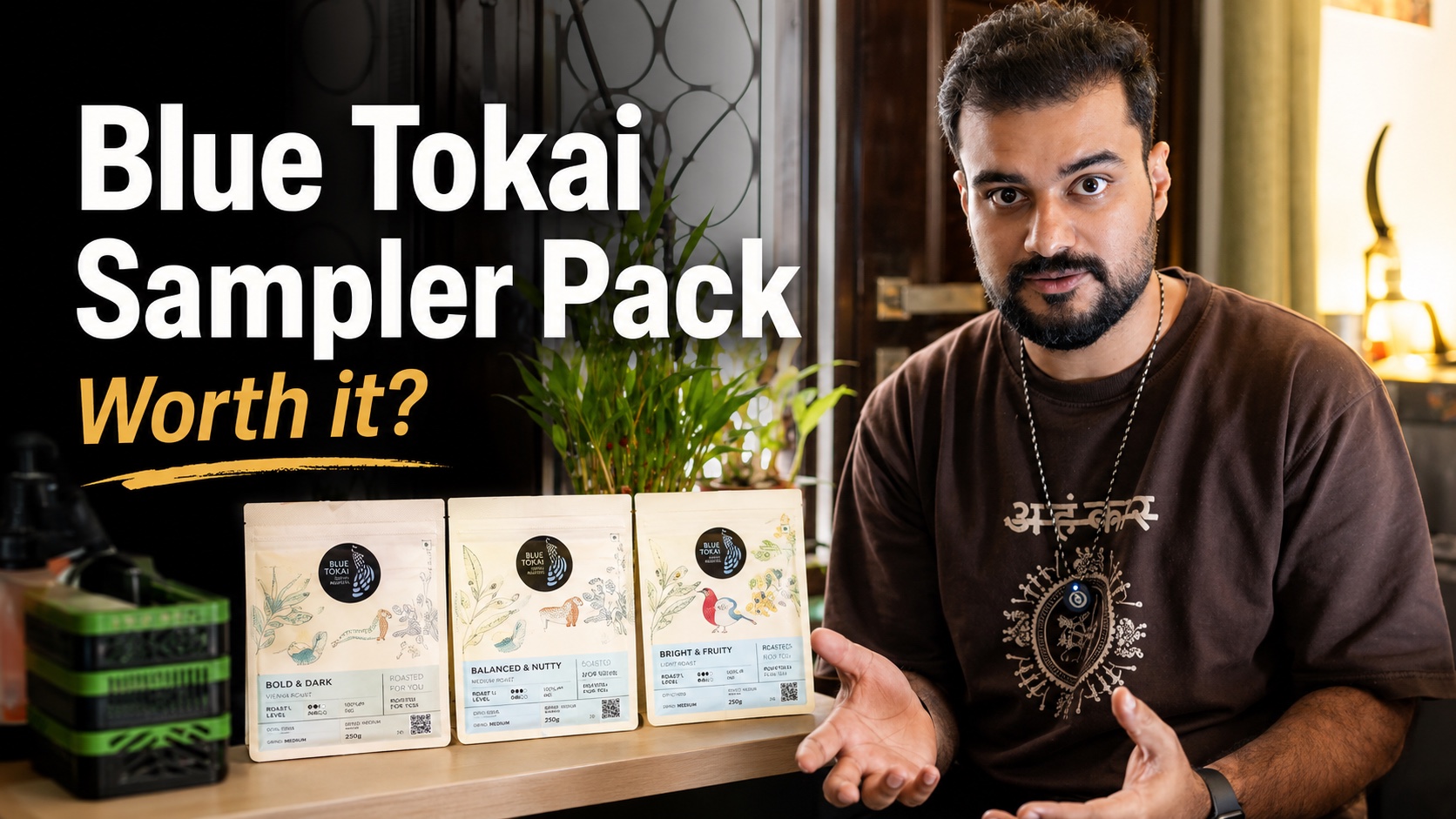
If you only came here to find out whether you should buy Blue Tokai’s 5-in-1 sampler pack, the short answer is yes.
It is particularly useful if you are new to specialty coffee and do not yet know whether you prefer bright, fruity coffees; balanced, nutty cups; or darker, more familiar roast flavours.
But the pack becomes genuinely valuable only when you treat it as a tasting exercise rather than five unrelated bags of coffee. Brew at least two coffees side by side, keep the method consistent, and pay attention to the differences. That is how a sampler becomes a shortcut to understanding your own palate.
What is in the pack?
Blue Tokai currently calls this the 5-in-1 Explorer Pack. It contains five 75 g pouches, giving you 375 g of coffee in total. You can order whole beans or select a grind suited to your brewing method.
The selection is designed to move across different flavour and roast profiles. The exact coffees may change, so check Blue Tokai’s product page before ordering. What matters is the range: instead of committing to a full bag before you understand what you enjoy, you get several smaller reference points.
At the time of this July 2026 review, Blue Tokai listed the pack at ₹1,170. Prices and included coffees can change, so consider that a dated reference rather than a permanent price.
Why this matters for a beginner
Many of us in India grew up with instant coffee: Nescafé, Bru, beaten coffee at home, or the version that became internationally famous as dalgona coffee during the pandemic.
There is nothing wrong with enjoying it. I still associate beaten coffee with rainy weekends and the coffee my mother liked making. But instant coffee tends to create the impression that coffee has one fundamental flavour, with differences mostly coming from milk, sugar, or brand.
Instant coffee is coffee that has already been brewed commercially and then dehydrated, commonly through spray-drying or freeze-drying. Adding water makes it convenient again, but it does not give you control over the original extraction.
Whole-bean and ground specialty coffee introduce a much wider range of decisions and flavours. The variety, origin, processing, roast, grind, water, recipe, and brewing method can all alter what reaches the cup.
That discovery is what made coffee fascinating to me. A familiar everyday ingredient suddenly became something with enormous variety.
A quick note about roast profiles
Roast labels are useful starting points, although they are not universal measurements and two roasters may use them differently.
If these labels are new to you, start with this explanation of light, medium, and dark coffee roast levels. It explains what roasting changes, why labels vary between roasters, and why lighter coffee is not automatically better coffee.
- Lighter roasts often preserve more origin character and can taste brighter, more floral, or more fruit-forward.
- Medium roasts often sit between clarity and roast development, with sweetness, fruit, nuts, caramel, or chocolate becoming easier to balance.
- Darker roasts usually emphasise deeper roast flavours, bitterness, cocoa, smoke, and a heavier impression in the cup.
These are tendencies, not rules. A light roast is not automatically sour, and a dark roast is not automatically bad. Your brewing choices still matter, as do the coffee variety, processing method, and quality of the roast.
The useful thing about the sampler is that you do not have to understand all of this theoretically before buying. You can taste the differences yourself.
The best way to use the sampler: an A/B test
The natural temptation is to finish one bag, open the next, and compare them from memory. I started that way too.
The problem is that taste memory is imprecise. Your water, recipe, breakfast, mood, and expectations may all be different by the time you reach the next coffee.
Instead, open the bags together and compare at least two coffees in the same session.
Use one repeatable recipe for the first comparison. The beginner guide to brewing better coffee at home explains how to hold the main variables steady and change only one thing at a time.
First comparison: keep the variables fixed
For your first pass, use:
| Variable | Keep it the same |
|---|---|
| Brewer | Use the same brewer for both coffees |
| Dose | Try 10–12 g per coffee if you want smaller cups |
| Ratio | Use the same coffee-to-water ratio |
| Water | Use the same water and temperature |
| Grind | Start with the same grind setting |
| Timing | Brew the coffees as close together as practical |
This is not necessarily the perfect recipe for either coffee. It is a controlled comparison that makes their differences easier to notice.
Taste them warm, then return as they cool. Ask simple questions:
- Which cup smells more inviting?
- Which one feels brighter or more acidic?
- Which one feels sweeter, heavier, or more bitter?
- Do you notice fruit, nuts, chocolate, spice, or roast?
- Which cup do you instinctively reach for again?
- Would you prefer either one with milk?
You do not need expert tasting vocabulary. “I like this one more” is already useful. Then ask why.
If you want a prompt rather than a list of flavours you feel obliged to detect, use the coffee flavour wheel as an observation tool. Begin with broad impressions such as fruity, nutty, chocolate-like, floral, or earthy before trying to name a specific fruit or spice.
Second comparison: help each coffee perform
Once you know which cup you prefer, brew your top two again and adjust them separately.
A lighter roast may respond well to a finer grind, hotter water, or a longer extraction. A darker roast may become more pleasant with slightly cooler water or a coarser grind. The right change depends on the coffee and method, but this second round helps separate the coffee’s underlying character from an imperfect first recipe.
This two-stage process gives you both a fair comparison and a chance to make each coffee taste its best.
What if you do not own a grinder?
Blue Tokai offers grind options for common brewing methods, so not owning a grinder should not stop you from trying the pack. Choose the option that matches the brewer you actually use.
Pre-ground coffee loses aroma and flavour more quickly after opening because much more surface area is exposed to air. If coffee becomes a regular hobby, a capable burr grinder is one of the most useful purchases you can make.
But do not turn that into another barrier. Drink the coffee with the equipment you have. The most important part of this exercise is brewing two samples together and noticing the contrast.
Who should buy it?
The sampler makes the most sense if:
- You are moving from instant coffee into freshly brewed coffee.
- You are unsure which roast or flavour profile you enjoy.
- You want to compare black coffee with milk-based preparations.
- You are choosing what kind of full bag to order next.
- You want a guided tasting exercise without buying five full-size bags.
It may be less useful if:
- You already know your preferred roast and flavour profile.
- You want one specific estate, process, or microlot.
- You would rather spend the same amount on a larger bag you already love.
- You will leave several bags open for a long time without storing them carefully.
After the comparison, use this practical guide to choosing the right coffee roast to connect what you tasted with the way you normally drink coffee, including whether you brew black coffee or add milk.
Before you order a full bag, decode the origin, process, roast and tasting notes on its label so the words support what you tasted rather than replace it.
The verdict
The Blue Tokai 5-in-1 sampler is worth buying, not because every coffee will necessarily become a favourite, but because the differences between them teach you something.
Five 75 g pouches give you enough coffee for repeated comparisons without forcing you to finish five large bags. Brew them side by side, take basic notes, and identify the cups you naturally gravitate towards.
Once you understand that preference, future buying becomes easier. You can explore Blue Tokai in Coffee Atlas, compare it with coffees from other Indian roasters, and make choices based on flavour rather than packaging or roast terminology alone.
That is the sampler’s real value: it helps turn “I like coffee” into a clearer understanding of which coffee you like, and why.
Watch the full review above, then use the Brew Tracker to save your side-by-side recipes and tasting notes.