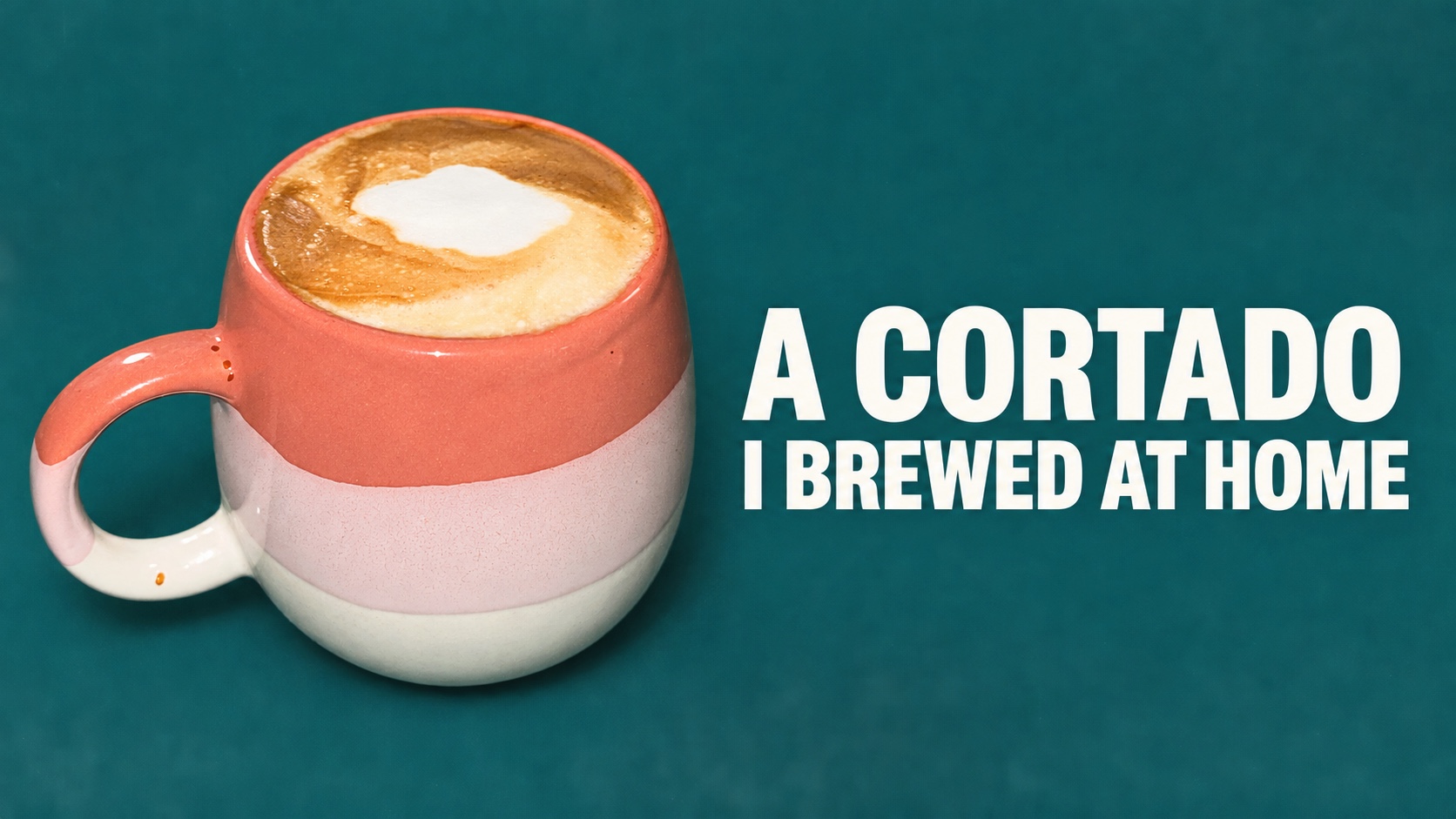
A cortado may be the simplest coffee drink with an identity crisis.
The instruction is almost comically short: make an espresso and cut it with a little warm milk. That is essentially what the Spanish name means. Yet ask five cafes how much milk constitutes "a little" and you may receive five different drinks, each presented with complete confidence.
My home recipe uses 36 grams of espresso and 60 grams of steamed milk. It produces a compact 96-gram drink in which the milk softens the espresso without making it disappear.
That is how I make a cortado. It is not the only possible answer, and that disagreement is part of the drink's story.
Where did the cortado come from?
The one part of the history we can state confidently is linguistic.
Cortado comes from the Spanish verb cortar: to cut. The Real Academia Española defines cafe cortado as coffee with very little milk. Its historical dictionary records that definition in a 1983 edition, although the drink and the spoken term will be older than their appearance in that dictionary.
The precise origin is much harder to establish.
You will find confident claims that the cortado was invented in the Basque Country, Valencia, or Madrid. I could not find a contemporary record identifying an inventor, cafe, city, or first serving. That does not make every origin story false. It means we should not turn a repeatedly copied possibility into documented history.
The more believable story is less cinematic. In Spanish-speaking coffee culture, adding a small quantity of milk was a practical way to cut the intensity of a short coffee. It was an instruction before it became an internationally marketed recipe.
That also explains why the ratio refuses to sit still.
So what is the correct cortado ratio?
There is no internationally enforced one.
La Marzocco's guide to building an espresso menu describes the cortado as espresso with steamed milk in a small glass and explicitly acknowledges regional variation. Equal parts espresso and milk is a useful starting definition, not a law.
Here is a practical spectrum:
| Espresso | Steamed milk | Ratio | What to expect |
|---|---|---|---|
36 g | 36 g | 1:1 | Intense, compact, and unmistakably espresso-led |
36 g | 60 g | 1:1.67 | My preferred cortado starting point: balanced but still coffee-forward |
40 g | 100 g | 1:2.5 | Softer and closer to the small cappuccino or flat-white territory I drink most days |
Cafe names are not units of measurement. Cup size, shot size, milk texture, local convention, and the cafe's own menu all affect what arrives. The useful question at home is not whether the Cortado Police approve. It is whether you can still taste the coffee after adding enough milk to make it pleasant.
My cortado recipe
For one small drink, use:
18 gcoffee36 gespresso in the cup60 glightly steamed milk in the cup- A cup or glass that holds roughly
100-130 ml
1. Pull a double espresso
I begin with an ordinary 1:2 recipe: 18 grams of coffee in and 36 grams of espresso out.
That ratio is a starting point rather than a commandment. Dial in the coffee before blaming the milk. If your shot is aggressively sour, hollow, bitter, or astringent, covering it with dairy will produce a softer version of the same problem. My larger guide to making espresso at home covers the complete workflow.
Medium and medium-dark coffees are the easiest place to begin. Chocolate, caramel, nut, spice, and dried-fruit notes usually remain legible through milk. A lighter coffee can make an excellent cortado too, but its acidity and fermentation character may become more surprising once concentrated into such a small drink.
2. Steam the milk lightly
A cortado does not need the large, dry cap of foam people sometimes associate with a cappuccino.
Introduce only a little air, then concentrate on building a smooth whirlpool. The finished milk should look glossy and pour as one integrated liquid. La Marzocco's milk-steaming guide describes the goal as a condensed, smooth texture with controlled, quiet aeration.
Use your smallest practical pitcher. You may need to start with more than 60 grams of cold milk to steam it comfortably; place the cup on a scale and stop pouring when you have added 60 grams.
I usually use Amul A2 cow milk or Amul lactose-free milk. The lactose-free milk has produced particularly delicious cups for me. Lactose-free dairy milk can taste sweeter because its lactose has already been broken into simpler sugars, but its exact steaming behaviour still depends on the product's protein and fat composition.
Heat the milk until it is sweet, silky, and immediately drinkable. It does not need to arrive hot enough to punish you.
3. Pour and drink
Swirl the espresso, swirl the milk, and pour steadily. Latte art is welcome but not required for admission.
I own small espresso-style cups that are slightly larger than conventional espresso cups. I also use sake cups, which are unexpectedly useful because some hold close to 100 grams of liquid. A transparent double-walled glass may be the most tempting presentation: you can see the dark espresso turn into that warm cortado brown as the milk enters.
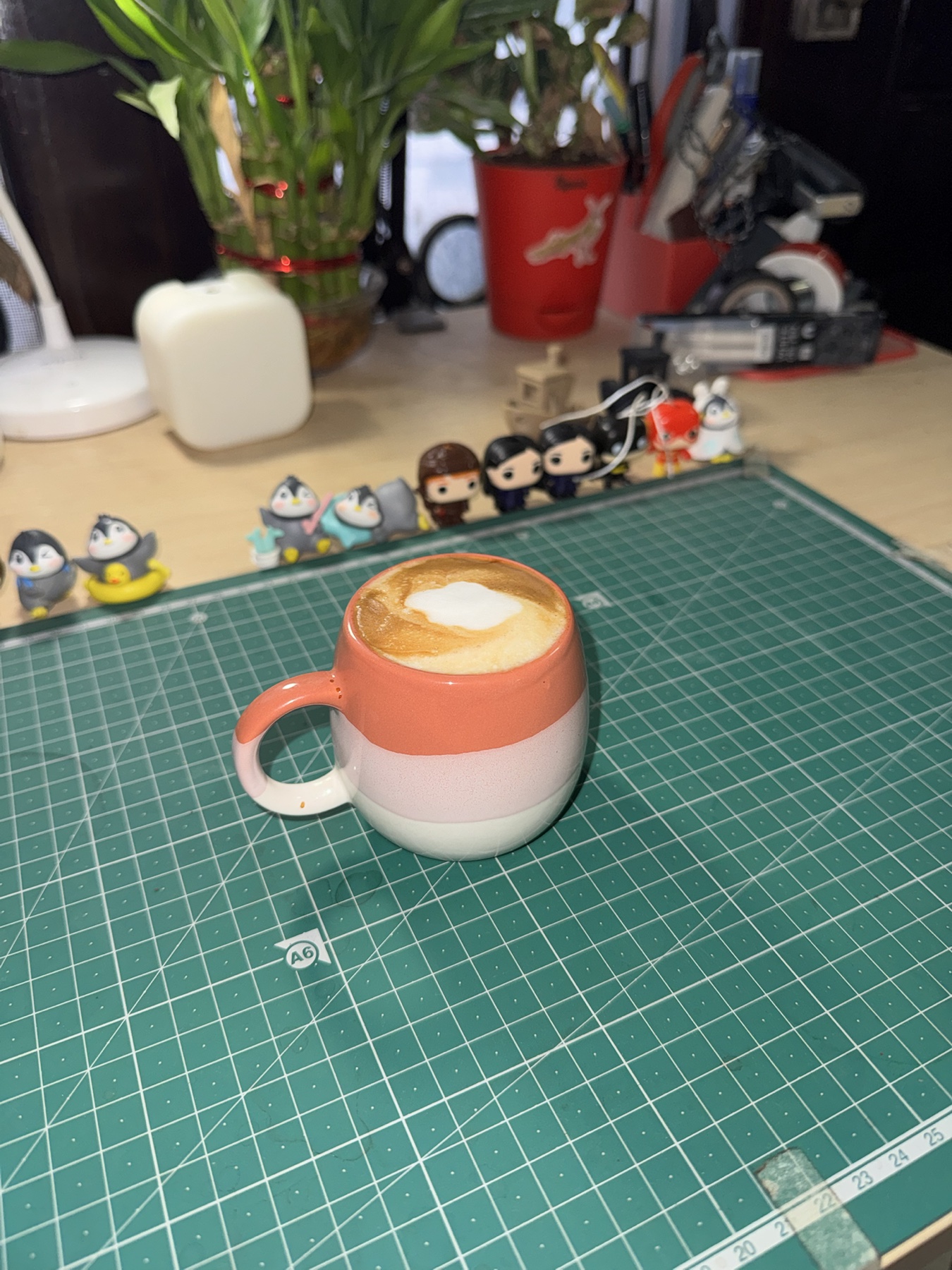
The cortado I brewed while working on this article. The cup is small, the desk is unmistakably mine, and the drink was delicious.
The drink is deliberately small. That is a feature, not evidence that somebody forgot the rest of your coffee.
The ratio experiment I still need to perform
One useful way to find your own definition is to split a 36-gram espresso across three cups:
12 gespresso with12 gmilk12 gespresso with20 gmilk12 gespresso with30 gmilk
You can compare 1:1, 1:1.67, and 1:2.5 without consuming three double shots. I have not yet performed this comparison systematically. When I do, I will add the results here rather than pretending I already know the outcome.
Can you make one with an AeroPress?
You can make a good cortado-style drink, but not a conventional cortado, because an AeroPress does not produce espresso at espresso-machine pressure.
The distinction matters technically and very little at breakfast.
AeroPress's own espresso-style recipe uses 19 grams of coffee, ground slightly coarser than espresso, with 60 grams of hot water. Stir for 15 seconds and press through a metal filter and flow-control cap. With an ordinary paper filter and cap, you can still brew a strong concentrate, although it will have less oil and texture.
For a home adaptation:
- Brew
18-19 gof finely ground coffee with60-75 gwater. - Press slowly into a sturdy small cup.
- Add roughly
50-60 gof warm, lightly frothed milk. - Taste before changing the recipe. Reduce the milk if the coffee vanishes; increase it if the concentrate feels harsh.
It will be less syrupy than an espresso cortado, but it retains the important idea: strong coffee deliberately softened by a restrained amount of milk. If you are new to the brewer, start with why I recommend the AeroPress to beginners.
What about a moka pot?
A moka pot can also make a cortado-style drink. This is a researched adaptation, not a method I regularly use.
I own a moka pot and have brewed with it, but it became largely redundant for me after I bought an espresso machine. I found it more demanding of constant attention and less predictable. Other home brewers use it extremely well, so my neglect should not be mistaken for a universal judgement on the brewer.
Do not under-fill a large moka pot merely because the final drink is small. Bialetti's Moka Express instructions recommend brewing the pot at its intended capacity: water just below the safety valve, a loosely filled basket of medium-fine coffee, and low-to-medium heat. Remove it once the top is full rather than allowing the coffee to boil and sputter into bitterness.
Then build the drink separately:
- Weigh
35-45 gof brewed moka coffee into a small cup. - Add
50-70 gof lightly textured milk. - Adjust the next drink by taste.
Expect less syrupy texture and no true espresso crema. Depending on the coffee and heat management, the moka version may also taste more roast-forward. It can still be delicious; it is simply not the same extraction wearing a different hat.
The cortado's accidental American cousin
The Gibraltar is a useful example of how easily a drink acquires a new identity when it changes cups and cities.
According to Blue Bottle's account, its Hayes Valley baristas had accidentally bought 4.5-ounce Libbey Gibraltar glasses that were too small for cupping. They began using the glasses to evaluate espresso, then added steamed milk to make the shots more approachable for regular customers.
Blue Bottle founder James Freeman later described the result plainly: it was really a cortado; they just did not know that at the time.
The glass gave the drink a San Francisco name. The underlying idea had already travelled much farther.
When should you drink a cortado?
There is no historically mandated cortado hour.
Make one when straight espresso feels more intense than you want, but a cappuccino or latte would bury the coffee under too much milk. Its small size also makes it useful when you want a complete milk drink without committing to a large cup.
That is ultimately why the cortado survives all the arguments about its definition. It occupies a useful space.
Espresso provides the structure. Milk cuts the sharpest edges. Neither ingredient gets to hide.