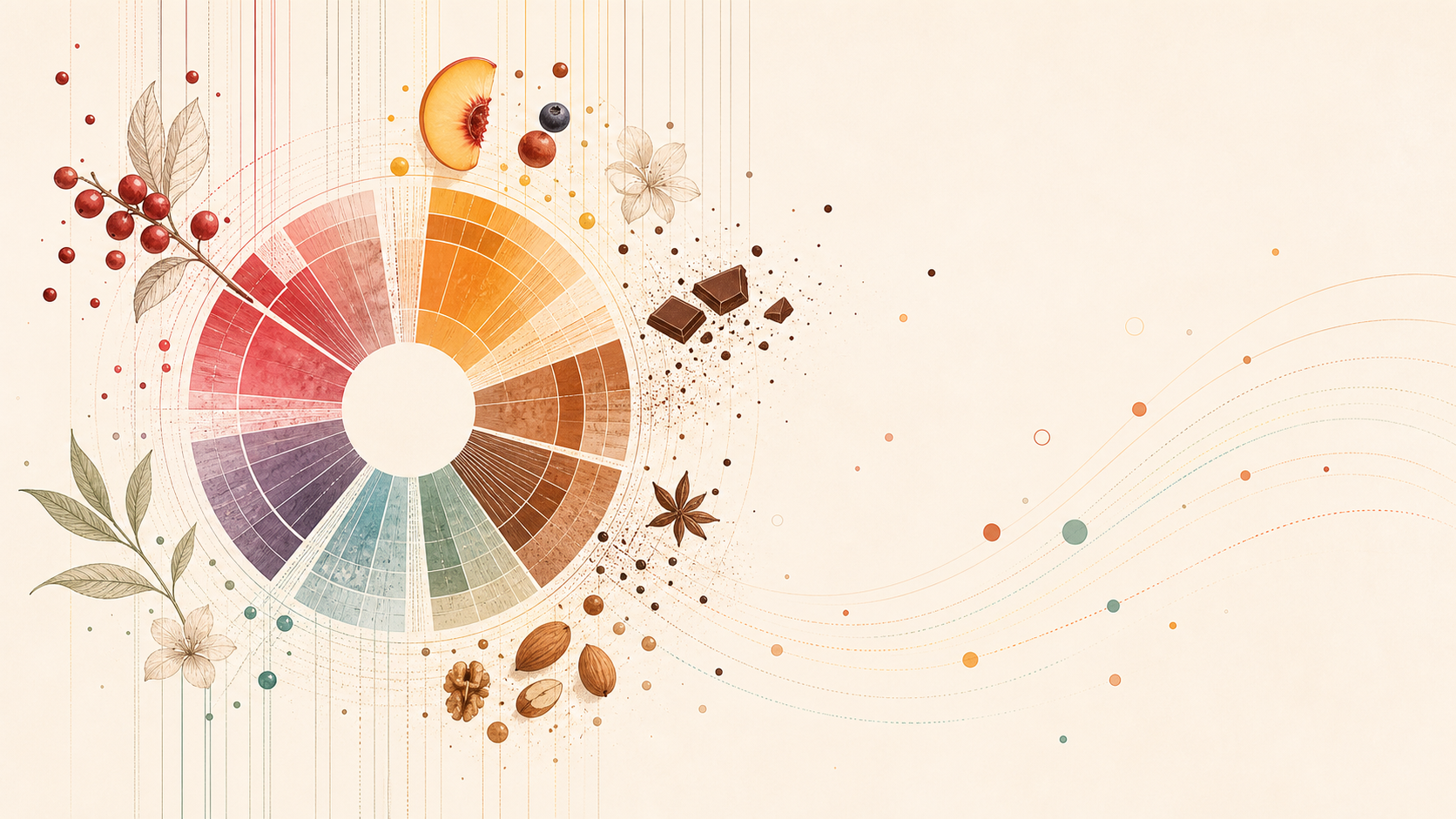
I have kept a coffee flavour wheel beside my brewing station for years. I still rarely reach the outer edge of it.
I can often tell that a coffee is fruity. Ask me whether that fruit is plum, cherry, or blackcurrant and I become much less certain. I can notice sweetness, sourness, bitterness, acidity, body, and how a coffee changes from its first impression to its finish. Exact tasting notes remain difficult.
That does not mean the wheel has failed me. It means I have been using it at the level my palate and vocabulary currently allow.
The most useful lesson for a home brewer is simple: "fruity" is already a valid tasting note. You do not have to reach "plum" to prove that you tasted the coffee correctly.
What is the coffee flavour wheel?
The Coffee Taster's Flavor Wheel was developed as a shared vocabulary for describing coffee. The modern version is connected to the World Coffee Research Sensory Lexicon, a research tool containing defined sensory attributes and references.
That professional origin explains both its usefulness and why it can feel intimidating in a kitchen. It was designed to help people communicate consistently, not to turn every morning cup into a blind sensory examination.
The Specialty Coffee Association's guide tells tasters to begin at the centre, where the categories are broad, and move outward only when they can become more specific.
That permission to stop is important.
You might move from:
- Fruity to berry to raspberry
- Sweet to brown sugar to molasses
- Roasted to burnt to smoky
- Spices to brown spice to cinnamon
But if all you can confidently say is fruity, sweet, roasted, or spicy, stop there. Honest general language is more useful than invented precision.
Flavour is not just what happens on your tongue
When people say "taste," they often mean the larger experience of flavour. Your tongue detects basic tastes such as sweetness, sourness, bitterness, saltiness, and umami. Aroma contributes much of the specific identity that makes lemon different from another sour food or jaggery different from plain sweetness.
Coffee adds another layer: mouthfeel. A brew may feel light, round, creamy, drying, thin, or heavy. The flavour wheel can help with aroma and flavour vocabulary, but it is not a complete map of everything happening in the cup.
This is why I ask broader questions before looking for individual fruits:
- What do I smell?
- Is the cup sweet, sour, bitter, or balanced?
- Does it broadly remind me of fruit, nuts, chocolate, flowers, spices, or roast?
- Does it feel light or heavy?
- What happens at the beginning, middle, and finish?
- Do I enjoy it?
The final question matters more than the most sophisticated answer.
Tasting notes are clues, not ingredients or promises
If a bag lists plum, jasmine, and jaggery, those ingredients were not necessarily added to the coffee. The roaster is describing associations found while evaluating it.
Printed notes almost always help me, but usually at a broad level. If a label says plum, I expect a certain fruit direction rather than demanding that my cup reproduce the exact experience of biting a plum. Fermented and intensely fruit-forward coffees can make those associations more obvious.
Caramelly's Frozen Cherry, for example, is currently presented as a light-medium Frozen Natural coffee with mango, mixed berries, and cherry characteristics. Coffees in that direction can make fruit and fermentation easier for me to notice, even when I would not independently name every fruit printed on the page.
Other cups are subtler. Sometimes I find only sweetness or acidity. Sometimes I disagree with the label. Brewing water, temperature, grind, recipe, roast age, and individual perception can all change what appears in the cup.
The label is not an answer sheet. It is one person's useful suggestion about where to look.
For more on what those label claims mean, read how to decode a coffee label.
Why an Indian flavour wheel matters
The standard wheel gave the coffee industry a common vocabulary. Common does not mean culturally universal.
A sensory reference only works well if the taster knows it. Someone who rarely encounters a particular berry cannot build a reliable memory merely because its name appears on a wheel. An Indian drinker may have a clearer sensory memory of mosambi, chikoo, jamun, amla, jaggery, kokum, cardamom, hing, or tulsi.
Blue Tokai created a Flavour Guide for Indian Coffees that builds on the SCA structure while adding more locally accessible references. Its wheel includes examples such as mosambi, chikoo, jaggery, cardamom, fennel, tulsi, curry leaf, and hing.
I have just printed it and plan to replace the standard wheel beside my coffee station with it. I cannot yet claim that it has transformed my tasting; I have not tested it for long enough. But the premise makes sense to me. After spending years unable to move reliably from "fruity" to a specific imported reference, vocabulary closer to my own food memory may reveal whether the limitation was partly linguistic rather than purely sensory.
That is a useful experiment, not a predetermined conclusion.
Decolonising the language of coffee
In a guest video on James Hoffmann's channel, Aramse co-founder Raghunath Rajaram explains how flavour can play a role in decolonising coffee. The argument is larger than adding Indian fruit names to a diagram.
Coffee-producing countries should be able to help shape the language, brewing culture, and value systems surrounding the product they grow. If a producer can describe a coffee through sensory references shared with a buyer, that producer participates more directly in how the coffee is understood and valued.
The same question appears in brewing equipment. A South Indian filter and a Vietnamese phin are not identical, but both use simple gravity-driven percolation through small holes and both developed within major Robusta-growing cultures. They should not be treated merely as quaint traditional objects while V60 and espresso are treated as the serious modern defaults.
Leave cultures with coffee and they build their own coffee cultures. The specialty industry should not require those cultures to translate every experience into a Western pantry or abandon their brewers before being taken seriously.
Localisation should still be rigorous. A professional sensory standard needs tested references, repeatability, and language people across a supply chain can understand. We should not replace one rigid vocabulary with a collection of clever but ambiguous metaphors.
For a home brewer, however, the starting principle is less complicated: use references you genuinely know.
What about "earthy"?
Aramse also raises an interesting example: earthy can be desirable in parts of the subcontinent, yet appears near musty and phenolic attributes on the standard wheel.
I enjoy earthy aromas. They can feel soothing and grounding, and they can sit comfortably with the darker coffees I like. That preference does not mean every musty cup is good.
"Earthy," "musty/earthy," "mouldy/damp," and "dirty" should not be collapsed into one idea. A pleasant association with soil, wood, spice, or roast is different from moisture damage, mould, or an obvious processing defect. The wheel can help us describe what we perceive, but cultural preference and quality judgement are not always the same task.
It is possible to like an attribute without declaring it universally superior. It is also possible to reject a defective cup without treating every earthy association as embarrassing.
Do not lie to yourself about what you taste
The easiest beginner mistake is to read the bag first and then force the cup to match it.
If the label says peach, suddenly every bit of acidity becomes peach. If another person says jasmine, the room fills with imaginary flowers. This creates impressive-sounding notes but teaches very little.
Taste first when possible. Observe without evaluation:
- I smell something fruity.
- The first sip is bright.
- The middle becomes sweeter.
- The finish is drying.
- This feels heavier than yesterday's brew.
Only then look at the wheel or bag and see whether a more specific word genuinely fits.
After two or three years, I am better at this than I was at the beginning. I can describe the movement of a cup more clearly, particularly in an A/B comparison. I am still not a professional taster, and I do not need to pretend to be one.
Palate development is less like unlocking a hidden superpower and more like learning to pay attention.
The cheaper comparison: brew one coffee two ways
The usual advice is to buy two different coffees and taste them side by side. That works, but it can make a learning exercise unnecessarily expensive.
Instead, brew the same coffee twice and deliberately change one variable. Because the beans stay constant, the contrast helps you notice what brewing does to flavour.
Try one of these:
- Brew once at 85 degrees Celsius and once at 95 degrees, keeping everything else the same.
- Brew the same dose and ratio as a normal V60-style percolation and with the immersion stage of a Hario Switch.
- Compare a hot brew with a cold brew made from the same coffee. This is a dramatic comparison rather than a controlled one, but the contrast will be easy to notice.
- Keep the brewer and water temperature constant, then compare a slightly finer and slightly coarser grind.
If you want to understand one variable properly, change only that variable. Comparing cold brew with V60 changes several things at once; it is useful for discovery, but it will not tell you which individual change caused every difference.
In my own brewing, using the Switch as an immersion brewer often gives me more perceived body than using it open like a V60. Your result will depend on the recipe, grind, filter, water, and coffee. The point is not to prove a universal rule. The point is to notice a repeatable difference in your cups.
A simple tasting exercise
You do not need two full mugs. Make two small brews using a total amount of coffee similar to your normal dose.
- Choose one coffee and one variable to test.
- Label the cups A and B before tasting.
- Keep the dose, ratio, grind, water, and pouring method identical except for the chosen variable.
- Smell the ground coffee, then notice the aroma after adding water.
- Taste both cups warm rather than scalding hot.
- Return as they cool; temperature can reveal or suppress different perceptions.
- Start with broad words before consulting the wheel.
Record:
- Aroma
- Broad flavour family
- Sweetness, acidity, and bitterness
- Body or mouthfeel
- Beginning, middle, and finish
- Which cup you preferred and why
You may write nothing more elaborate than:
Cup A is lighter and sharper. Cup B is rounder, sweeter, and easier for me to drink.
That is useful sensory information. It can guide your next recipe even if neither cup reminds you of a named fruit.
Log both versions in Brew Tracker so the comparison does not disappear from memory. Over time, repeated observations become your personal sensory vocabulary.
Tasting as attention
In meditation, you may learn to notice the breath without immediately judging or controlling it. Coffee can offer a smaller everyday version of that practice.
Notice what is on your tongue. Notice what reaches your nose. Notice the texture, temperature, beginning, and finish. Do not rush to decide whether the cup is sophisticated enough or whether your vocabulary sounds expert.
Observe without evaluation, and distinctions gradually become clearer.
The flavour wheel is useful because it can give those distinctions names. An Indian flavour wheel may give more of us names connected to memories we already possess. Neither wheel can taste the coffee for us.
Start broad. Compare one coffee against itself. Use words you understand. Most importantly, tell yourself the truth about what is actually in the cup.
Sensory comparison becomes much easier when the recipe is controlled. Use the beginner guide to brewing better coffee at home to establish a repeatable baseline before deciding that every difference came from the coffee itself.
If you want several contrasting coffees for the exercise, the Blue Tokai sampler review shows how to compare them without turning the flavour wheel into an answer sheet.