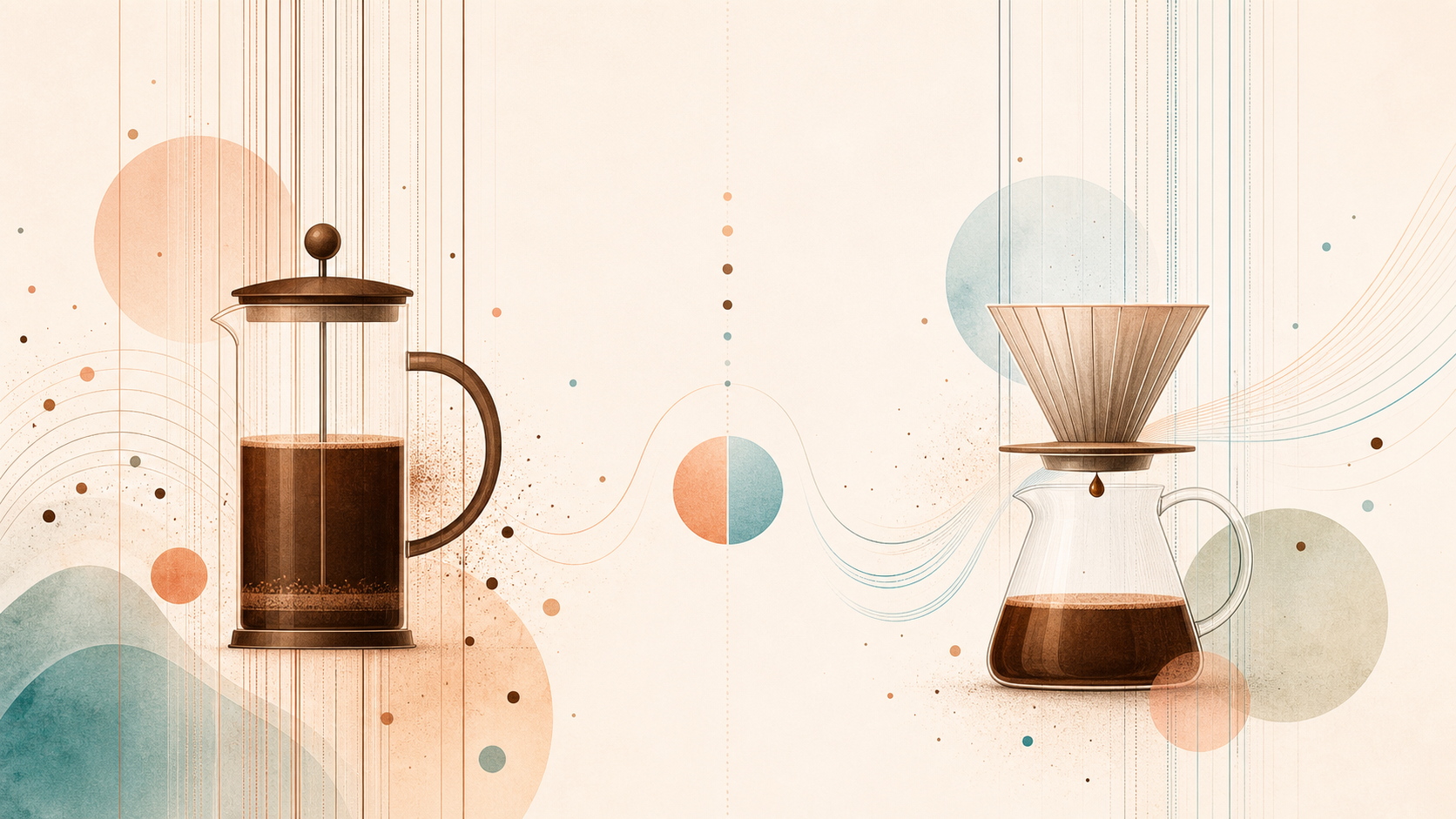
If you want the shortest possible answer, choose a French Press for low-effort, full-bodied coffee and a pour-over brewer for clarity, control, and a technique you can keep learning.
Neither is inherently better. They ask different things from you and show you different parts of the same coffee.
That distinction matters because coffee gear culture can make the French Press look old-fashioned and a new pour-over dripper look automatically sophisticated. I do not agree with that hierarchy. A French Press can make excellent specialty coffee. A V60 can make a disappointing cup. The brewer does not rescue stale coffee, bad water, or a recipe you have not learned.
The right first brewer is the one whose daily process you will actually tolerate.
My experience with both methods
I do not currently have a French Press on my coffee shelf, although there is probably a generic one somewhere in my house. I may have originally bought it from Blue Tokai. That uncertainty does not mean I am unfamiliar with the method.
I have been drinking French Press coffee at restaurants and cafes for more than 20 years, long before I entered specialty coffee. At one Mumbai restaurant, I was even served green tea in a French Press. The format was already familiar and established: a glass or metal vessel arrives at the table, you wait, press, and pour.
Later, at a previous workplace, one of my colleagues used to bring a French Press to the office. We tried different coffees in it and treated it as a practical shared brewer rather than a precious piece of specialty equipment.
My pour-over experience came later and became much more equipment-heavy. I own or have regularly used:
- A Hario V60
- A Hario Switch
- A ceramic Origami dripper
- A CAFEC Deep 27
- A Kalita Wave
- An Orea brewer
- Other pour-over brewers at workshops and friends' homes
That list reveals the cultural difference between the two categories. Many people buy one French Press and keep using it. Pour-over enthusiasts can spend years comparing cone angles, ribs, bypass, paper shapes, flow rates, flat beds, and recipes.
That experimentation can be enjoyable. It can also distract you from the coffee.
The fundamental difference: immersion versus percolation
A French Press is an immersion brewer. The ground coffee sits in the full volume of water while it extracts. A metal mesh then separates most of the grounds from the drink.
A conventional pour-over is a percolation brewer. Fresh water travels through a bed of coffee and exits through a paper filter. Your pouring pattern affects which grounds encounter water, for how long, and with how much agitation.
That is why the experiences feel so different.
With French Press, you add coffee and water, make sure everything is wet, and wait. With a V60, I remain present while blooming, pouring in stages, watching the water level, and waiting for the drawdown.
Contact time alone does not determine extraction. Grind size, water temperature, agitation, ratio, roast, and filter all matter. A pour-over can extract more than a French Press, or less. What changes most reliably is how the cup is filtered and how much control the method gives you during brewing.
What does French Press coffee taste like?
French Press coffee usually feels heavier and more textured to me.
The metal mesh allows oils and very fine particles into the cup. That can create:
- More body
- A rounder or denser texture
- More sediment
- Less separation between individual flavour notes
- A cup that feels familiar and comforting
I would not say that a French Press removes acidity. A bright coffee can remain bright. But its acidity may feel less isolated because it arrives inside a fuller, more textured cup.
This is one reason the method works well for someone who wants coffee rather than a sensory exercise. Add grounds, add water, leave it alone, and return to something substantial.
It is also possible to make a relatively clean French Press. James Hoffmann's Ultimate French Press Technique uses a long settling period and avoids aggressively plunging through the grounds. It is the video I send to friends who own a press because it demonstrates how much technique is still available inside an apparently basic brewer.
What does pour-over coffee taste like?
Paper-filtered pour-over usually gives me more clarity.
The paper captures oils and small particles that pass through a French Press mesh. The result often has:
- A cleaner texture
- Less sediment
- Lighter body
- More obvious acidity
- Better separation between aroma and flavour notes
Even a brewer that produces a relatively full pour-over cup, such as my CAFEC Deep 27, generally shows more clarity than a French Press.
That does not make clarity the universal definition of quality. Sometimes I want a light, articulate cup. Sometimes I want coffee that feels dense and comforting. A brewer is a way of interpreting a coffee, not a ranking system.
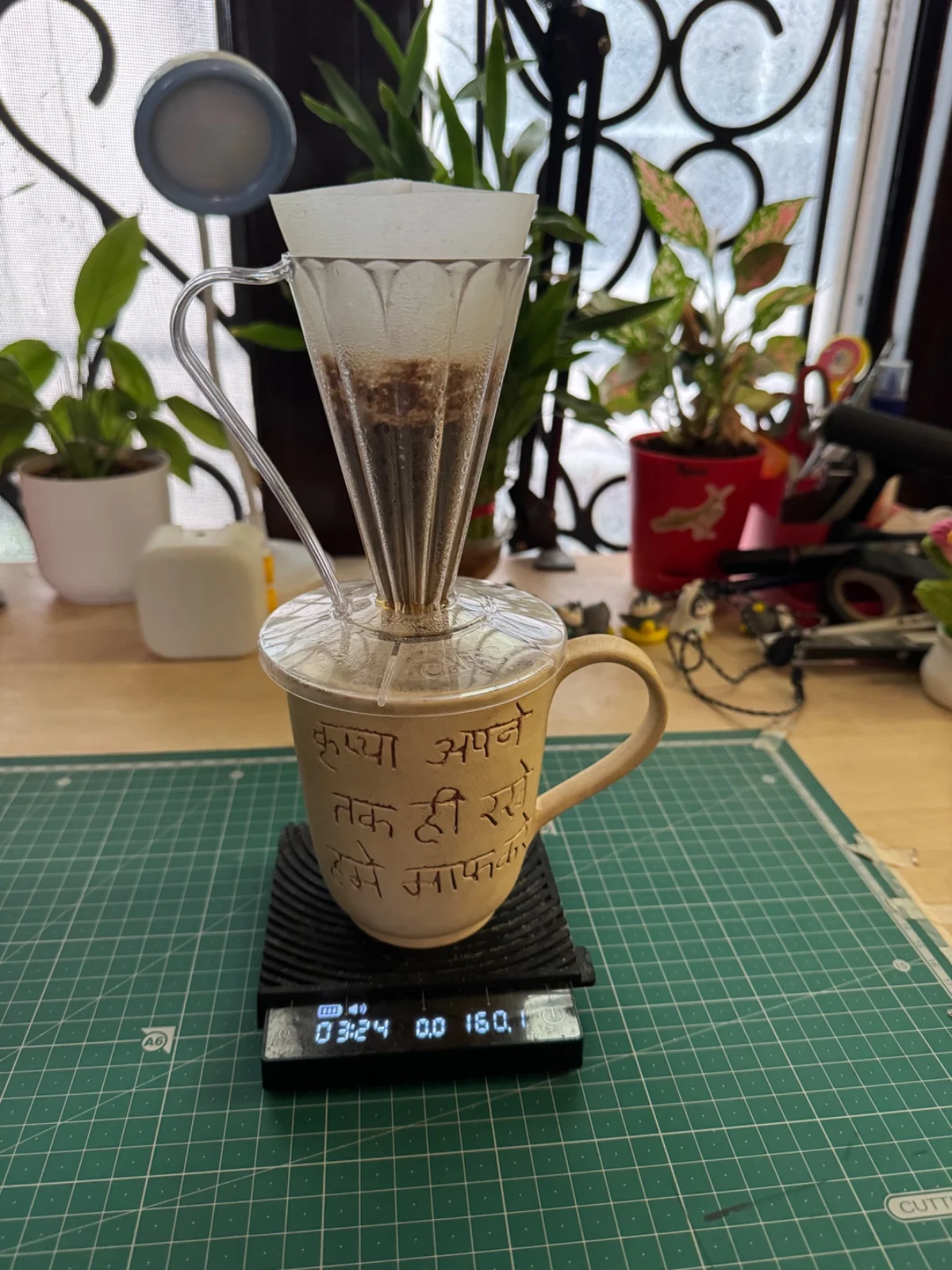
My CAFEC Deep 27 on a scale during a home brew.
Which method works with light, medium, and dark roasts?
Both can brew all three.
I do not believe you need to reserve French Press for dark coffee and V60 for light coffee. That creates another unnecessary rule for beginners.
A light roast in a French Press may emphasise body over delicate separation, but it can still be delicious. A dark roast in a pour-over can be balanced if you adjust temperature, grind, ratio, and agitation rather than attacking it with the same recipe you use for a dense light roast.
The more useful rule is to learn one brewer and adjust deliberately. If a cup is sour or thin, you may need more extraction. If it is bitter, harsh, or drying, you may need less. The coffee roast-level guide explains how roast changes what a recipe asks from you.
Which one is more forgiving?
French Press is generally more forgiving of technique.
Once your coffee is in a sensible grind range, you do not need a controlled spiral pour or a perfectly level bed. The grounds and water spend enough time together for small pouring errors to become irrelevant.
Its main practical weakness is sediment. Grind much too fine and more particles can pass through the mesh. Stir aggressively or pour carelessly after the coffee has settled and you can disturb the bed at the bottom. You may end up with a gritty final sip.
Pour-over gives you more opportunities to change the cup and more opportunities to damage it. Grind, temperature, ratio, bloom, pour height, flow rate, agitation, paper, and drawdown can all affect the result.
With my Deep 27, for instance, I may use a five-pour recipe. That means I have to stay present. A poor pour can wet one part of the bed more than another. A grind that is too fine can stall the drawdown. A grind that is too coarse can let water pass before enough flavour has been extracted.
The reward is control. The cost is attention.
How much time and attention do they require?
A French Press may remain on the counter for several minutes, but most of that time is passive. Add the ingredients, set a timer, and do something else while it steeps and settles.
A pour-over may finish drawing down in roughly two to four minutes, depending on the brewer and recipe, but the active portion is concentrated. You are standing there with the kettle, watching the scale, and deciding when and where to pour.
The complete ritual can take five to ten minutes once grinding, heating, rinsing, brewing, and cleanup are included. It does not need to consume half an hour. It does ask you to be mentally present.
That can be either the reason you buy it or the reason you avoid it.
Which is easier to clean?
Pour-over wins by a narrow margin.
Lift out the paper filter with the grounds, compost or discard it, and rinse the brewer. The paper keeps most residue contained.
With a French Press, the spent coffee remains inside the vessel. You need to remove the wet grounds, rinse the mesh and chamber, and occasionally disassemble the plunger for a more thorough clean. Do not wash a large mass of grounds down the sink if you can avoid it.
Neither method is difficult to clean. French Press is merely a few steps more awkward.
Do you really need a scale, gooseneck kettle, and expensive grinder?
You do not need all three to make your first pour-over. You are likely to want them if you keep going.
A scale improves repeatability. A gooseneck kettle gives you better control over flow and placement. A more consistent grinder produces a narrower spread of particle sizes, which can make drawdown and extraction easier to understand.
Each improvement is real, but expectation also matters. New equipment creates attention and excitement, and that can make every new cup appear transformed. Test changes rather than assuming price guarantees flavour.
I demonstrated the equipment difference in how to brew coffee without a coffee maker. I used an IKEA funnel and a kitchen towel, then compared it with a Hario V60 and its paper filter. The improvised cup was drinkable. The V60 cup was noticeably cleaner, more complex, and easier to reproduce.
Purpose-built equipment helps. That is different from saying you need the most expensive version.
French Press asks less from the supporting gear. You still benefit from a scale and a consistent grinder, but you do not need a gooseneck kettle because there is no precise pouring pattern to control.
A dependable place to start
For French Press, begin with a simple ratio around 60 grams of coffee per litre of water, or scale that down to the amount you drink. Use a medium-to-coarse grind as a practical starting point, make sure all the grounds are wet, and give them time to steep and settle. Hoffmann's linked technique is useful if sediment is your main objection.
For V60, use one published recipe rather than combining advice from five videos. Hoffmann's Ultimate V60 Technique is the method that originally helped me understand the brewer. Hario also publishes a written version of that recipe, built around a 30 g coffee to 500 ml water ratio, a bloom, two controlled pours, and a final swirl.
You can scale and adapt either method later. First learn what one repeatable recipe tastes like.
What about milk?
French Press naturally gives you more texture and can stand up comfortably in a milk-forward cup, especially with medium or darker coffee. It is not espresso concentrate, so adding a large amount of milk can still make it taste weak.
Pour-over is most rewarding to me when drunk black because clarity is the reason I chose the method. You can add milk if that is how you enjoy coffee; there is no purity test. Just recognise that delicate acidity and aroma may become less visible.
If milk drinks are your primary goal, a South Indian filter, moka pot, or AeroPress concentrate may fit that job better than either option.
Who should buy a French Press?
Buy one if you:
- Want good coffee with very little active technique
- Prefer body and texture over maximum clarity
- Do not want to buy a gooseneck kettle
- Often brew more than one cup
- Want a brewer that can also infuse tea
- Prefer a morning routine you can leave alone for a few minutes
Do not choose it first if sediment bothers you, you want a very clean tea-like cup, or the part of coffee that excites you is manipulating pour patterns and comparing papers.
I would not say serious enthusiasts should avoid French Press. That would repeat the snobbery I disagree with. It may simply offer fewer visible equipment paths than pour-over, which can make it feel less exciting to someone who wants the hobby as much as the drink.
Who should buy a pour-over brewer?
Buy one if you:
- Primarily drink coffee black
- Enjoy clarity and distinct flavour notes
- Want technique to be part of the ritual
- Are willing to weigh coffee and water
- Want to learn how grind, pouring, and agitation change extraction
- Do not mind being present throughout the brew
Do not begin here if you want to add coffee and water, walk away, and return to a finished cup. A V60 looks simple because it is a cone with a hole. Its simplicity makes your technique more visible rather than less important.
Where do AeroPress and Hario Switch fit?
In my personal ranking, both are more versatile first purchases.
The AeroPress is still the brewer I recommend to almost everyone. It combines immersion, paper filtration, and manual pressure in a compact format. It can produce a full cup, a short concentrate, or many variations between them.
The Hario Switch is a V60-shaped brewer with a valve. Leave the valve open and it behaves like a pour-over. Close it and it becomes an immersion brewer. Open and close it during a recipe and you can build hybrids: percolation for clarity during one phase, immersion for more body during another.
A steep-and-release brewer such as the Clever Dripper offers a similarly low-attention idea: steep the coffee, place the brewer on a cup, and let it drain.
That flexibility is wonderful if coffee is your hobby. It can also turn Sunday morning into three hours of recipe variations. You do not need endless possibility to make a good cup.
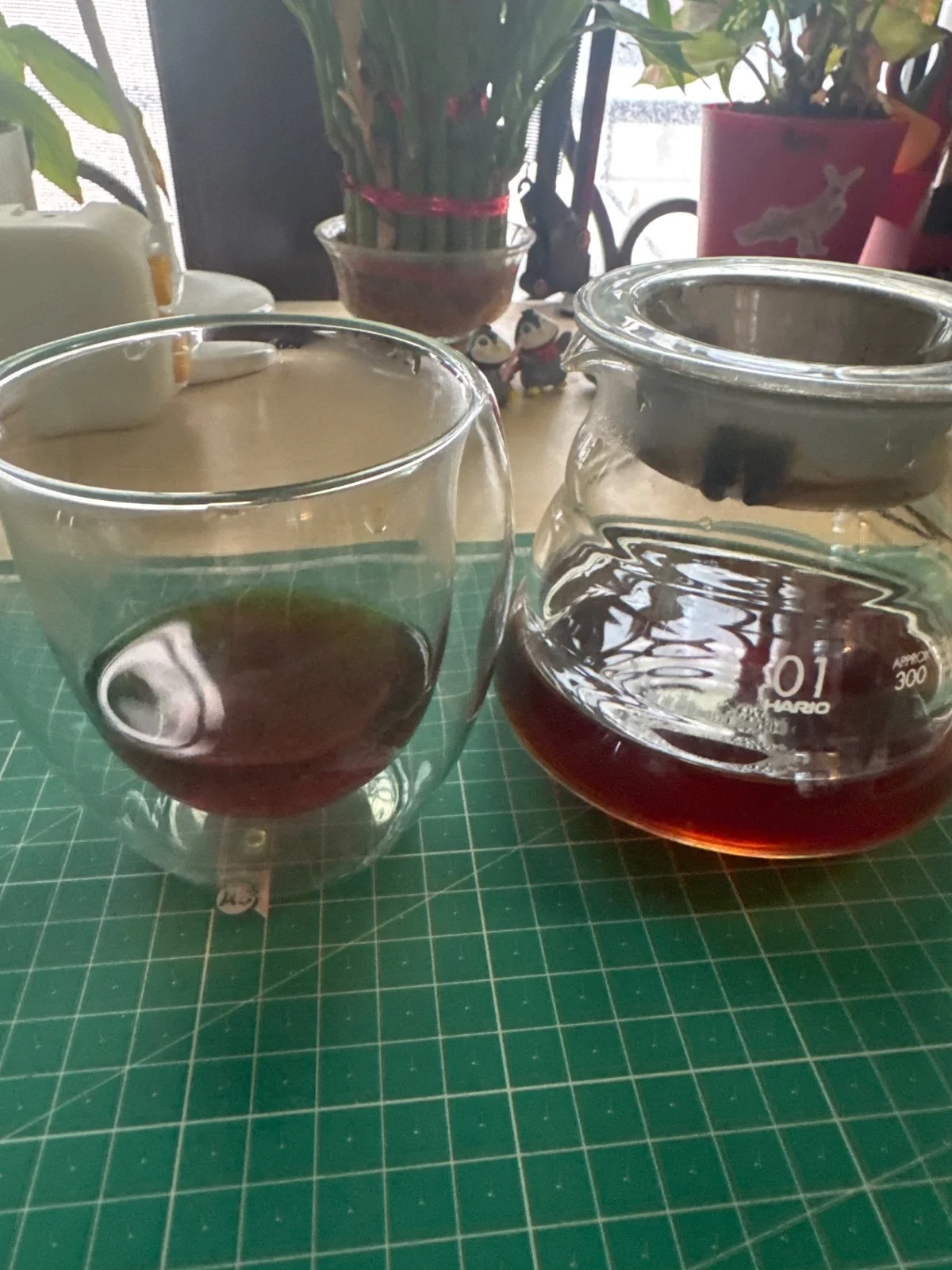
A finished brew made with my Hario Switch, which combines immersion brewing with a paper filter.
The status problem with French Press
French Press is not discussed with the same excitement as newer brewers in the specialty-coffee groups I follow.
Post a photograph of an unusual new dripper and people ask where they can buy it. Post a French Press and someone may treat it as though it does not belong in specialty coffee.
Who decided that?
French Press is old, proven, easy to understand, and capable of brewing excellent coffee. None of those qualities became invalid because a newer brewer has more interesting geometry.
Gear comparison is useful until it makes us dissatisfied with a cup we enjoyed before seeing someone else's setup. The final drink is not aware of the status attached to its brewer.
My recommendation
If the decision is strictly French Press versus pour-over:
- Choose French Press if you want an easy, low-attention cup with body.
- Choose pour-over if you want clarity, technique, and a hobby that can keep expanding.
If you ask me to recommend any first brewer, I still choose the AeroPress because it sits between these experiences and travels well.
Whichever brewer you choose, resist the urge to rank it against every object online. Buy fresh coffee, learn one recipe, observe what changes, and decide whether you enjoy the result.
The beginner guide to brewing better coffee at home shows how to establish that repeatable dose, grind, water temperature, and brew time before buying another brewer.
If you are budgeting for the rest of the setup, the beginner coffee-equipment guide explains which grinder, scale and kettle decisions matter for these two methods and which can wait.
A French Press and a V60 do not compete to reveal which owner understands coffee better. They simply show different sides of the same beans.