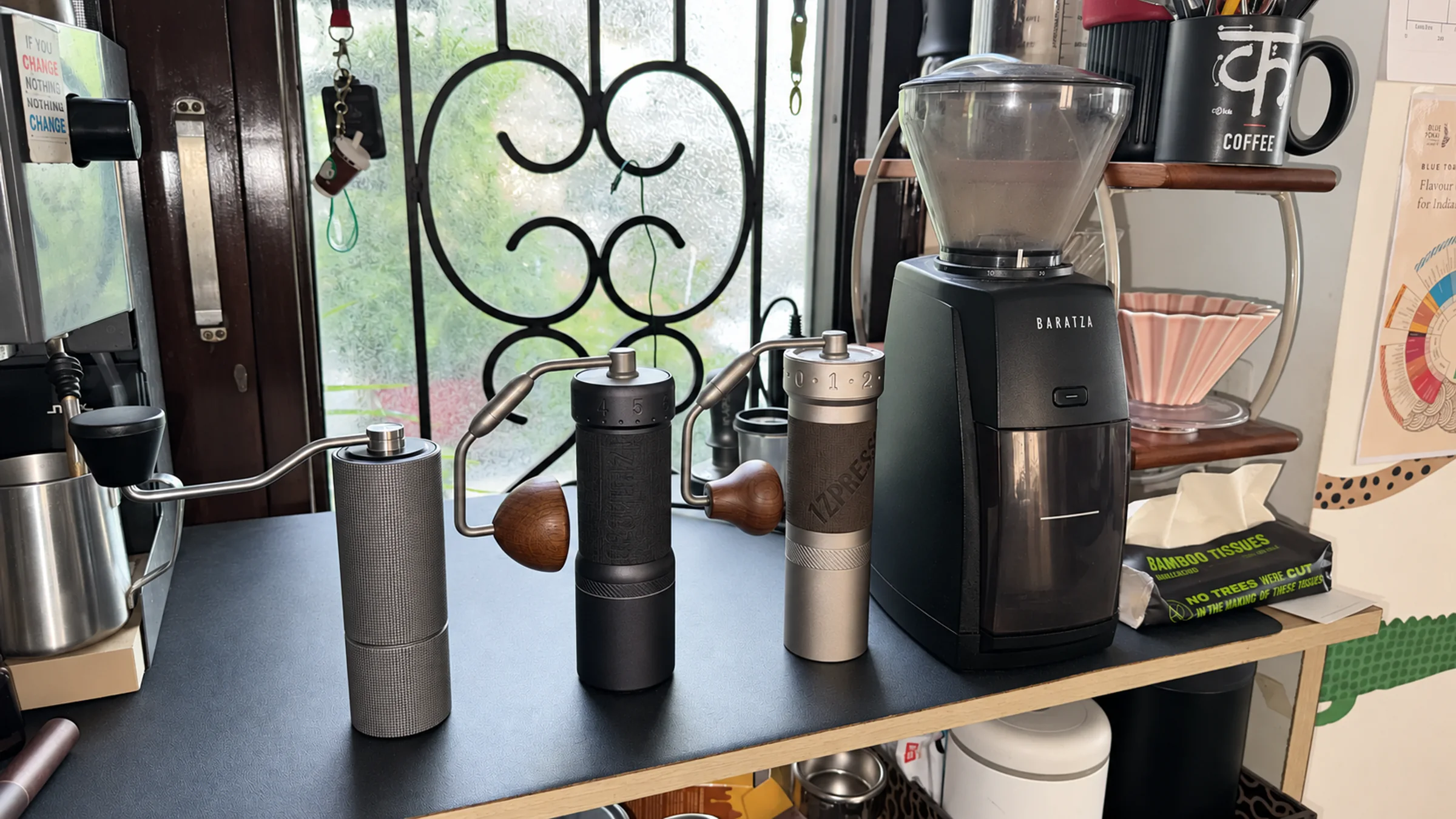
I bought my Timemore C2 four years ago. This January, I bought a ZP6. Since then, I’ve barely touched the C2 for pour-over.
That probably sounds like the conclusion of this article already. But until now, I hadn’t brewed the same coffee with both grinders and tasted the cups right next to each other.
Now that I have, I can say there was a huge difference. They were the same coffee, but the ZP6 made the cup I wanted to keep drinking. It was sweeter, juicier, and especially enjoyable as it cooled.
The C2 still made good coffee. And that’s what makes this comparison interesting.
I am not saying that the ZP6 is SO much better than the C2 that everyone should buy it. But it IS a huge step up. Especially if you are into pourovers and are committed to the coffee hobby.
In this article I am going to try and help you make the upgrade decision. Should you upgrade? Or should you stick to your budget grinder. And how much are you missing out exactly? Let’s get into it.
How the C2 became my first grinder
Four years ago, I was in New York working on my thesis and becoming increasingly obsessed with coffee.
Honestly, it was a great distraction. My thesis was stressful, and coffee gave me something else to think about. There was always something to read, a recipe to try, or a small change to make to the next brew.
I’d had my AeroPress (opens in a new tab) for about two months. Every couple of weeks, I would buy coffee from a store and get it ground there.
The first few brews would taste good. But towards the end of the bag, sometimes two or three weeks later, the coffee just wasn’t quite the same. I wasn’t getting as much flavour out of it as I had at the beginning.
So I started looking at grinders.
Buying one felt like the next thing I could do to improve my coffee. I could buy whole beans and grind only what I needed, right before brewing.
The Timemore C2 wasn’t that expensive, and it seemed like a great purchase. I was genuinely excited about it. And almost immediately, there was a jump in the quality of the coffee I was making.
It also felt solid and well built. It didn’t feel like something I would need to replace as soon as I became more interested in coffee.
For quite some time, it was my only grinder. I made cups I really enjoyed with it, and I didn’t feel like I was missing something every time I brewed.
That matters here. The C2 did a lot right.
A few years—and a few grinders—later
In 2023, I was back home and earning. I bought myself a Gaggia Classic Pro and a Baratza Encore ESP.
Now I could make espresso at home, which, of course, gave me an entirely new set of things to obsess over.
The ESP also gave me another option for pour-over. Despite the name, it isn’t restricted to espresso: Baratza gives it a separate filter range covering settings 21–40. So I could use either the C2 or the ESP when I wanted to make filter coffee. Baratza’s quick-start guide (opens in a new tab)
Later, I decided I wanted more control over my espresso and bought a J-Ultra.
I’ve really enjoyed that grinder. After hearing a reviewer I trusted speak well of its filter coffee, I started trying it for pour-over too. In the comparisons I made at the time, I preferred those cups to what I was getting from the C2.
That was interesting because I hadn’t bought it for filter. 1Zpresso positions the J-Ultra specifically for espresso, with coated 48 mm burrs and an adjustment mechanism offering 8 microns of movement per click. But it became another way for me to explore pour-over as well. J-Ultra specifications (opens in a new tab)
By then, I already had several ways to grind coffee. My manual vs electric grinder guide (opens in a new tab) covers how I use them. Another grinder wasn’t exactly a necessity.
But in January this year, I finished a project and decided to reward myself.
I bought the ZP6.
Why the ZP6?
Part of it was curiosity. Part of it was wanting a grinder specifically for pour-over. And, honestly, part of it was wanting to make sure I wasn’t missing out.
I’d heard so much about the ZP6. People kept talking about how clearly it presented flavours and how much they enjoyed the coffee it made.
Eventually, you start wondering: is there something in my coffee that I’m not tasting?
I already owned grinders that made coffee I liked. But I wanted to know what a filter-focused grinder could give me with the same beans and water.
The ZP6 also has a genuinely interesting history.
The grinder people wanted brought back
In August 2022, Lance Hedrick reviewed the original ZP6, which was difficult to get hold of and hadn’t been made widely available internationally.
In his account, a friend named Mark in the Philippines had sent him one to try. Lance loved it.
He also described messages suggesting that some local customers found the coffee too clean, even watery, and that this had made the company hesitant to push it more widely. That was his account of the feedback and not a claim that everyone in Taiwan wanted the same kind of coffee. Lance’s original review (opens in a new tab)
But what hadn’t appealed to those customers was precisely what made the grinder exciting to him. Here was a hand grinder producing the sort of filter coffee he wanted, and most people watching couldn’t buy it.
So he asked people to make some noise about it.
By late 2022, the ZP6 Special had arrived. Asser Christensen, writing from his own testing for The Coffee Chronicler, describes its relationship to earlier regional models and its use of a K-Pro-style body with a filter-oriented burr set. Christensen’s testing and model history (opens in a new tab)
And that’s what I like about this story. A grinder that had struggled to find an audience got another chance and became a favourite among people looking for exactly that kind of cup.
Lance helped draw attention to it, but the enthusiasm didn’t stop with him. Other reviewers and home brewers tried it, enjoyed it, and kept the conversation going.
The Special also differs from the original. 1Zpresso describes a finer adjustment mechanism, with 90 clicks per rotation on the external dial. Throughout this article, when I say ZP6, I mean the ZP6 Special. 1Zpresso’s model description (opens in a new tab)
Where the Pietro comes into the conversation
If you spend enough time reading about filter-focused hand grinders, you’ll also come across the Pietro.
Lance helped design its Pro Brewing burrs. Pietro describes them as filter-focused, with an emphasis on reducing fines and controlling the distribution of ground particles. Lance’s disclosure (opens in a new tab), Pietro’s explanation (opens in a new tab)
That was the side of coffee I wanted to explore. The ZP6 gave me a way to do it without buying another electric grinder.
What is different about the grinders?
The C2 and ZP6 both use steel conical burrs. You put beans in, turn the handle, and collect your grounds.
But the burrs and adjustment systems are different.
The original C2 combines metal and plastic components, with a steel axle and dual bearings. Prima’s early hands-on demonstration covers its use for methods including AeroPress, V60 and French press. Prima’s C2 demonstration (opens in a new tab)
The ZP6 Special has 48 mm stainless-steel burrs and an external dial. That dial is a practical difference: I can see and change the setting without removing the catch cup. ZP6 Special specifications (opens in a new tab)
But bigger burrs aren’t a guarantee of better coffee. Their diameter alone doesn’t explain the difference I tasted.
What about the C2S?
C2S owners will probably recognise a lot of this discussion, but this test is of my original C2.
Timemore describes the C2S as having an upgraded full-metal construction while retaining a 38 mm steel-burr format. It belongs in the same conversation, but I wouldn’t assume that every result from my C2 applies exactly to it. C2S specifications (opens in a new tab)
The same goes for other budget grinders. They aren’t all identical, and this isn’t a comparison of every affordable option against every premium one.
It’s a comparison of two grinders I own.
The coffee and the brewing
For this test, I used Araku’s Monsoon Edit.
It’s a coffee I’ve enjoyed, and I wanted to see what both grinders would do with it.
Araku describes the current release as a light-medium omni roast combining washed and naturally processed coffees, with notes including black raisins, roasted almonds, caramelised apples, sapota and malt. Those are the roaster’s descriptors, rather than a checklist of everything I tasted. Araku Monsoon Edit (opens in a new tab)
I used 10 grams of coffee for each brew:
- Timemore C2: 20 clicks.
- ZP6 Special: setting 6.0.
One cup was brewed in a Hario Switch used as an ordinary V60, without an immersion stage. The other was brewed in a separate Hario V60.
I used the same water and followed the same pouring process. The dose and brew time were the same too.
Both grinders had been taken apart and cleaned about a month earlier. The ZP6 had had several months of regular use by this point, while the C2 had been getting much less attention.
Were the grind sizes the same?
I can’t claim that 20 clicks on the C2 equals 6.0 on the ZP6.
The settings describe adjustments on two different grinders. They don’t tell us that the grounds have identical sizes or the same proportions of fine and coarse particles.
This was a home comparison using those settings, not a measured particle-size match.
I also used two separate brewers rather than brewing both cups in the same device. I followed the same process, but that is worth being clear about. It doesn’t make the tasting useless; it means I shouldn’t present it as a laboratory test isolating the grinder alone.
What it does tell me is how these two cups tasted next to each other.
How the cups tasted
The same coffee, but not the same experience
My first impression was that the cups had a lot in common.
That makes sense. They were made from the same beans, and the C2 wasn’t producing something unrecognisable. A lot of the coffee’s character was there in both cups.
But as I kept drinking, I enjoyed the ZP6 cup more.
It was sweeter and juicier. The flavours felt easier to notice, and the coffee became particularly enjoyable as it cooled.
The C2 cup felt heavier. There was more body, and a bitterness that sat through the middle of the sip. I could still find some of the same sweetness and juiciness, but they didn’t feel as apparent.
If I think about the sip from beginning to end, the C2 gave me some of that lively character at the beginning and again towards the finish. In the middle, though, the heavier, more bitter impression seemed to take over.
That’s where I noticed the biggest difference.
What “tea-like” meant to me here
You hear people describe the ZP6 as producing tea-like coffee. After this comparison, I have a better sense of what that means to me.
It didn’t mean weak or flavourless.
The ZP6 cup felt lighter, but there was plenty going on. The sweetness and acidity were easier for me to appreciate without that heavier impression sitting in front of them.
With the C2, the sweetness was still there. It just felt less obvious, almost hidden behind the weight and bitterness of the cup.
That’s how I experienced it. I’m not saying body causes bitterness, or that a full-bodied coffee can’t be sweet. In this particular brew, those sensations arrived together and made the cup feel less expressive to me.
The difference grew as the coffee cooled
This was probably the most memorable part of the tasting.
By the last few sips, the ZP6 cup was lovely. It felt lively, sweet and juicy. I was having more fun drinking it as it cooled, and I kept noticing how enjoyable it had become.
The C2 remained heavier.
It was still good coffee, but it didn’t open up in quite the same way for me. The ZP6’s final sips are what I remember most strongly: that feeling of, “Oh, this is a really good cup.”
It wasn’t just easier to describe. It was the cup I wanted more of.
Would I have enjoyed the C2 on its own?
Absolutely.
I kept saying this in the video because I think it’s important.
If someone had handed me the C2 cup without the ZP6 beside it, I would have enjoyed it. I would probably have said it was a nice cup of coffee.
For years, that was more or less my experience. The C2 was my grinder, and I made coffee I liked. I wasn’t regretting the purchase or thinking every cup needed better equipment.
It was putting the two next to each other that made the difference so apparent.
The C2 had plenty of what I enjoyed about the coffee. The ZP6 presented it in a way I preferred.
And, honestly, part of me was relieved.
I paid considerably more for the ZP6. If I’d put the cups beside each other and found nothing worth noticing, I would have wondered what I’d spent all that money on. And I would’ve been really upset with myself!
That expectation is also worth acknowledging. I knew which grinder made each cup; this wasn’t a blind tasting. But my preference during this comparison was clear.
What I think the result means
A noticeable difference—not a universal score
Immediately after tasting, I found myself thinking that if the ZP6 cup represented 100, the C2 was giving me something like 60 or 65 of that enjoyment.
That’s an expression of how substantial the difference felt to me. I am not making comparisons based on caffeine extraction and particle size.
The cups shared a lot of characteristics. But by the last sip they felt like two different coffees.
With the ZP6, the sweetness and juiciness stayed with me. With the C2, the heavier middle of the sip made some of that harder to appreciate.
For this coffee, brewed this way, I much preferred the ZP6.
Can I explain it entirely through fines?
Not from this test.
Different grinders produce different distributions of particle sizes. My guide to grinding coffee (opens in a new tab) explains why grind size matters. Fine particles can affect how water moves through a coffee bed and can contribute to filter clogging. That gives us a useful way to think about differences in brewing behaviour. Jonathan Gagné’s explanation of fines migration (opens in a new tab)
But I didn’t measure the grounds, beverage strength or extraction. I can’t work backwards from “this cup felt heavier” and claim I’ve proved exactly what caused it.
What I can describe confidently is the tasting: the C2 cup felt heavier and more bitter through the middle, while the ZP6 cup felt sweeter, juicier and more lively as it cooled.
That is enough to make the comparison useful without inventing a scientific explanation for every sensation.
Other people don’t always prefer the same thing
Owner discussions are a useful reminder that the ZP6’s profile isn’t everyone’s favourite.
One long-term owner who had previously used a C2 described the ZP6 as a major improvement, while acknowledging that another grinder could suit certain coffees better. Long-term ZP6 discussion (opens in a new tab)
Another owner reported that, after years of use, they thought they preferred the C2’s cup profile. C2 preference discussion (opens in a new tab)
Those experiences don’t cancel out mine. They remind me that an upgrade involves preference as well as price.
I liked what the ZP6 did with Monsoon Edit. Someone else might want a different presentation—or get a different result with another coffee and recipe.
Should a beginner buy a premium grinder?
I don’t think this comparison means everyone starting out needs a ZP6.
The C2 did so much right for me. It let me grind fresh, make enjoyable coffee, and learn what happened when I changed my brewing.
At the time, I didn’t have a ZP6 cup sitting beside every C2 cup. I was simply making coffee at home and enjoying it.
That’s a good place to be.
There’s plenty to learn with a capable budget grinder: choosing coffee you like, getting comfortable with a recipe, understanding your water, and making small adjustments by taste.
If you’re enjoying the coffee, you don’t need to turn every possible improvement into an urgent purchase. My beginner equipment guide (opens in a new tab) covers what is worth buying first, and how to brew better coffee at home (opens in a new tab) is a useful place to work on the basics before upgrading.
But I also don’t want to pretend the difference was insignificant just to make the conclusion sound reassuring.
In this comparison, it wasn’t. The ZP6 made a substantially more enjoyable cup for me.
So I can hold both thoughts at once: the C2 was a great first purchase, and the ZP6 is an upgrade I’m glad I made.
Which one will I travel with?
Before doing this comparison, I might have picked the C2 for travel without thinking too much about it.
It’s smaller and more compact, and I feel comfortable taking it somewhere rougher. That’s my confidence in a grinder I’ve owned for years, rather than proof that it is more durable than the ZP6.
Now, though, I’m more inclined to carry the ZP6 when I want to make good pour-over away from home.
The difference in these cups was enough that I’d like to have that experience while travelling too. It also comes with a useful carrying case.
But it depends on the trip.
If I expect the grinder to get knocked around, or I don’t want to worry about carrying something more expensive, I’d still take the C2. I know it can make coffee I enjoy.
It hasn’t become useless because I prefer another grinder.
So, was the ZP6 worth it?
For me, ABSOLUTELY.
The most useful thing about this comparison wasn’t discovering that the C2 made bad coffee. It didn’t.
It was discovering that two cups could share plenty of the same character and still give me quite different experiences.
The C2 cup was enjoyable. The ZP6 cup was the one I kept getting excited about, especially towards the end. It felt sweeter, juicier and more alive as it cooled.
Four years ago, the C2 made my coffee better. It was an affordable purchase that gave me a lot of enjoyment, and I don’t regret it.
The ZP6 has now given me something extra that I can appreciate directly—not just because I read about it, or because it cost more, but because I preferred the coffee beside me.
This was my first direct comparison of these two grinders, with one coffee and one brewing approach. I’d like to repeat it, try other coffees, and see how consistently that difference shows up.
But for now, the lasting memory is pretty simple.
The C2 made a nice cup of coffee.
The ZP6 made the cup I wished hadn’t finished.